Roster Analysis: Colorado Mesa WLAX
Colorado Mesa enters 2027 with a roster of 34 players, one more than last season, putting them slightly above average in terms of size. The Mavericks are coming off a disappointing campaign and will be looking to get back to the level of play that fans had grown accustomed to in recent years. Whether they can do that depends largely on how well they replace significant losses in two key areas.
The draw-control unit faces a substantial rebuilding challenge. Colorado Mesa returns just 48% of their draw-control experience from last season, with the departure of Sophie Astone leaving a particularly large void. Astone was in the 91st percentile for total draw-control-related production, posting 52 draw-control wins and 11.0 draw-control-related EGA over her career. That kind of production doesn’t just walk through the door. The good news is that Avery Irlbeck, who was in the 89th percentile for draw-control production and recorded 47 draw-controls last season, is back and should be ready for a larger role. Still, last year’s unit finished in the 52nd percentile nationally on an opponent-adjusted basis—solid but not spectacular—and losing their top contributor could push them backward if Irlbeck and others can’t fill the gap.
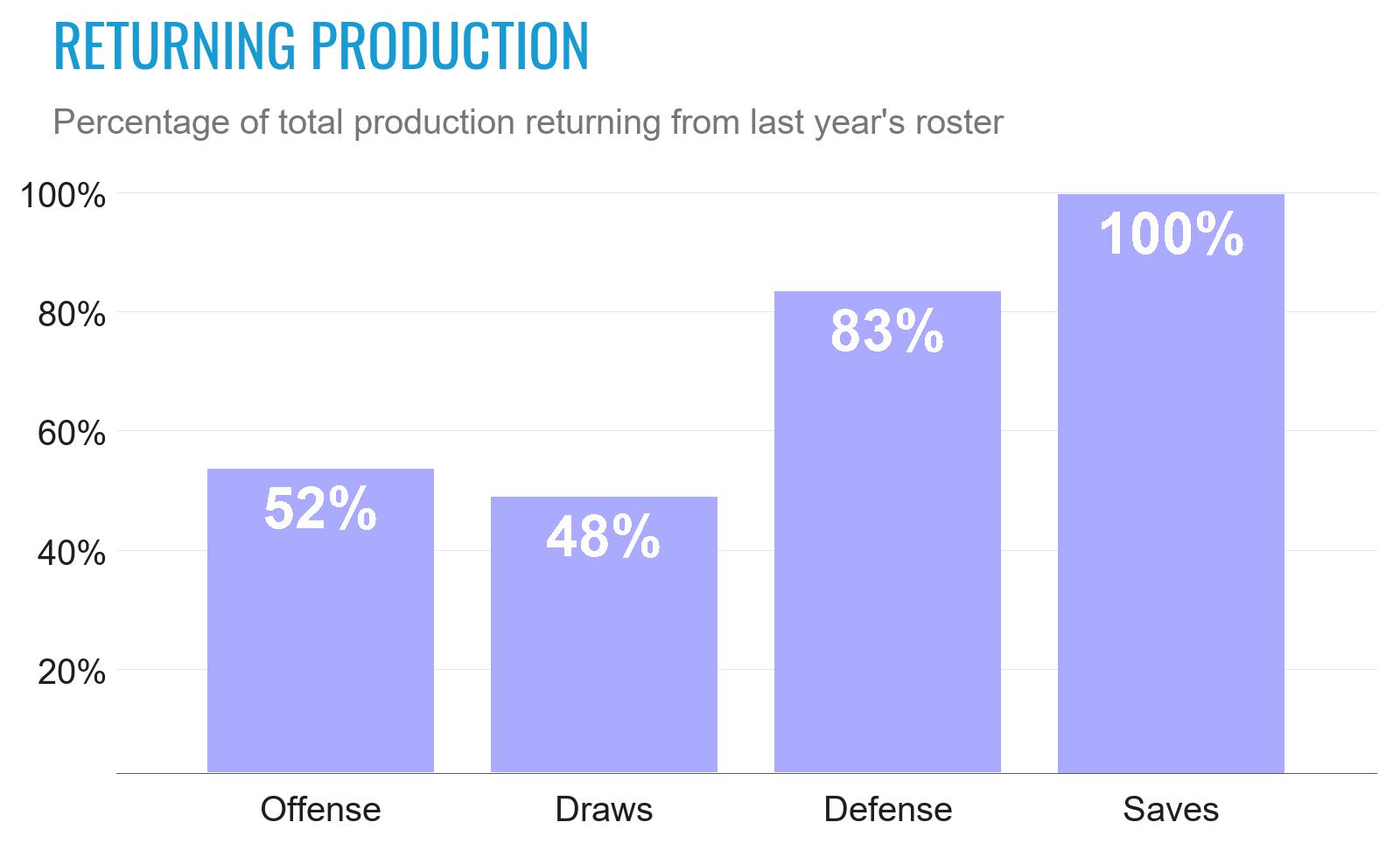
The offensive side of the ball presents similar concerns. The Mavericks return only 52% of their offensive production, meaning nearly half of what they generated last year walked out the door. Devon Morris was the biggest loss, accounting for 14% of the team’s offensive production and 14% of their assists while posting an individual efficiency rating in the 92nd percentile. Replacing that kind of efficient playmaking is a tall order. Courtney Havel, who contributed 12% of their offensive output, is also gone. Colorado Mesa’s offense finished in the 30th percentile nationally last season, so they were already looking to improve—and now they have to do it with new faces. Kaylee Kittle could be poised for a breakout; she was in the 60th percentile for total production with an efficiency rating in the 81st percentile, took over 10% of the team’s shots, and has room to grow. Sadie Chappuis, while more limited offensively (38th percentile for production, efficiency rating in the 15th percentile), is another player who could see expanded responsibilities.
The defensive side of the ball provides more stability. Colorado Mesa returns 79% of their defensive experience, and three of their top four defenders—Chappuis, Monroe McClimans, and Sofia Chock—are back. The only significant loss is Olivia Turk. This unit finished in the 76th percentile last season, making it a relative strength, and the continuity suggests they could be even better this year. Perhaps most importantly, Heather Hawkins returns in net after appearing in 18 games, facing 343 shots, and posting a 45% save percentage. The Mavericks finished in the 71st percentile nationally for save percentage, and having a proven goalkeeper back should provide a solid foundation. Sophia Bailey, who appeared in two games and faced just five shots, also returns as depth.
The picture that emerges is one of a team with real questions on offense and at the draw circle but a defense that should remain competitive. Whether Colorado Mesa can get back to the strong seasons they’d grown accustomed to will depend heavily on internal development. If players like Irlbeck and Kittle can step into larger roles and produce efficiently, the Mavericks have the defensive backbone to compete. If not, this could be another season of growing pains.
Expected Goals Newsletter
This was originally published in our daily newsletter, Expected Goals, on Oct 25th. If you want to get more coverage and analysis like this, straight in your inbox every morning, sign up here. It’s free and over 1,300 other lacrosse folks have signed up.


