My Thoughts on PowerWise vs NPI
The thing that I most dislike about the current selection process is the arbitrariness of the process. The committee has so many criteria that they are forced to consider that whatever decision they make is going to be supported by one of them. We just don’t know which it will be until the brackets are released.
I’ve always thought that an algorithmic selection would be better simply because it would remove that arbitrariness and allow teams to balance program development with building a schedule that could make them competitive as an at-large. The experience of DIII in using NPI has given us a real-world data point that the system can work.
But now, there is a new contender for the one algorithm-to-rule-them-all: PowerWise, which got a very positive write-up in USA Lacrosse Magazine.
If it were a choice between the current system and using PowerWise to automate the process, I’d probably pick PowerWise. The transparency that you get from an algorithm is very valuable.
But if we are going to go away from the current system, NPI is also an alternative. If it were up to me to decide which way we go, I’d pick NPI. (For what it’s worth, PowerWise is a pair-wise-based system like what NCAA hockey used for years. They don’t anymore. They switched to NPI.)
I did not design NPI or PowerWise and I have no stake in either being selected, but my experience in replicating the two systems gives me a unique perspective on how they work and what they would mean for the sport. I think it’s important to poke and prod on something as important as a system that is going to select our at-large teams. I hope PowerWise fans do not mind the examination. (And to be clear, I love that this idea is showing up in the pages of USA Lacrosse Magazine; thank you to all involved for moving the debate towards automation!)
The Zack Worldview
For transparency before we dive in, I wanted to lay out my preferences when it comes to the selection process. I think it’s important for you to understand what I value so that you can contextualize what follows.
- I love it when a mid-major has a shot at making the NCAA tournament as an at-large. It’s great that every team has a shot at an AQ, but it’s also tough when a great team’s season hinges on a 2 or 3 game tournament; it makes the regular season feel irrelevant.
- I’ve never been particularly moved by the desire to have only the “teams that could win it all” in the field; I view an at-large as a reward for a successful season. If a team that is better “on paper” is left out, I’m fine with that.
- I think the current process puts way too much weight on a team’s wins against the top-20 in the RPI. (The big conferences just have way more chances to pick up these kinds of wins.)
- Conversely, I don’t think enough weight is put on losses outside the top-20 and wins over good, but not great, teams. A team could win 6 or 7 games against teams in the RPI 21-30 range and those wins are rarely going to affect a selection decision.
- I have concerns about how NPI would be implemented in Division I and specifically whether the configuration of the weights would introduce incentives toward less exciting schedules. I assume that if NPI were adopted, there would be a consultative process to determine the settings and dials; I certainly wouldn’t copy and paste the DIII weights into a DI context
Ok, let’s roll…
My Description of Powerwise
Here’s my understanding of the PowerWise system. First, you need to calculate a power ranking for every team. They do this by using the final scores to identify the “best” teams. This is the part where goal-differential matters; two teams could play the same schedule and beat the same teams and end up with different rankings because of goal-differentials. There is also an adjustment to favor road victories.
Now that you have that ranking in place, you start to look at game results. The mechanism for calculating a PowerWise score is to compare every team against every other team. Each individual match-up is worth a single point and your final PowerWise score is based on how many of these one-on-one points you win. For a given “match-up”, there are 3 steps.
First, you look at whether Team A beat Team B. If Team A had a better head-to-head record, then Team A gets the point for that individual match-up.
If Team A did not beat Team B, then the next way to determine the point is common opponents. If Team A has a better record than Team B against the teams they both played, then Team A gets the point. (Unless they share only a single opponent, then this step is skipped.)
If those two steps did not decide things, then you go to the power ranking and the higher ranked team gets the point.
At-large selections would be made based on whoever has the higher PowerWise score.
The Framework of the Debate
The conversation around PowerWise vs NPI sometimes veers into the technical and academic. But I don’t think that’s really the right way to think about this decision. The technical details obscure the fact that this is a question of values.
Roughly 40% of the points awarded in the PowerWise system end up being decided based on who has the better Power Rating (based on goal differentials alone; not record or wins and losses). A selling point of the PowerWise system is that its predictive power means that better teams have higher rankings, regardless of the actual win-or-lose outcome of their games.
Do you want the NCAA tournament to have the teams that are most likely to win NCAA tournament games regardless of their wins and losses? Or do you want the NCAA tournament to be the teams with the best resumes? If you prefer the former, you might be inclined toward PowerWise. If you prefer the latter, you want NPI.
But there is a second dimension here. Moving to an algorithm that values margin-of-victory would undeniably change the culture of college lacrosse. Any changes that would be caused by moving to NPI would be minor in comparison. To justify the more drastic change to our sport, I think it’s fair to want to be sure that the juice is worth the squeeze.
On the dearth of data
One of the arguments made by the proponents of PowerWise is that it uses goal-differentials to work around the small sample-size “problem” of lacrosse playing a smaller number of games than other sports. In PowerWise, you get more credit for a larger margin-of-victory up to 7 goals. In this way, instead of every game being just a win or a loss, the algorithm has more data to chew on and it can produce more precise ratings. (I was very intentional about using the word precise rather than accurate.) This merits 3 observations.
To start, I think the small-sample size argument is overblown in the first place. Take this year’s bubble conversation. The teams that I heard about most heading into Selection Sunday were Duke, Yale, Harvard and Maryland. You know who NPI would have had hovering around the cut-line? Yep: Duke, Yale, Harvard and Maryland.
NPI would have had Ohio State in the mix as well (it doesn’t penalize them for those wins over bad teams like our current system does), but the point here is that even with the number of games we are already playing, the teams in the mix for that last spot would have been exactly the same. They all have faulty resumes and nobody would feel bad for Harvard being the first-team out under NPI just like nobody is howling about Harvard being left out of the actual bracket.
I have always heard this argument: we can’t use an algorithm because there aren’t enough games played in college lacrosse. I have never heard an argument for why that is true, and I think NPI has shown that it’s not necessarily a concern in the first place.
Second, the elephant in the room with PowerWise is that it incentivizes teams to win by 7 or more goals. There were 134 DI MLAX games in 2026 that were decided by more than 3 goals, but less than 7; these are comfortable victories. That’s out of 553 pre-NCAA tournament games (24% of the total). In a PowerWise system, in every one of those games, the coach who is up by 4, 5, or 6 goals is going to feel pressure to keep starters in longer and shrink their bench.
That is the tax that we have to pay in exchange for this extra data. But given what NPI has shown us: do we really need to pay the margin-of-victory tax in exchange for this extra data?
And that brings me to my final observation, PowerWise makes the assumption that this extra data is valuable. (To be fair, this is less an observation than voiced skepticism.) I don’t think it’s cut-and-dry that it is.
Obviously, the thing that matters most is whether you won the game or lost the game. Beyond that, every extra goal has diminishing value as a data point. The PowerWise algorithm has been trained on years of games in which there was no incentive to run up the score. What happens when that incentive is introduced?
“When a measure becomes a target, it ceases to be a good measure” (google the extensive world of Goodhart’s Law). I suspect we will see a lot more 7-goal margins of victory and maybe hear some clamor to raise the goal cap to 8 or 9 in the future.
Proponents of the system cite a York MLAX game against Albright from 2025 where York “only” won by 2 goals against the #210 team in the NPI. They write:
Since the NPI disregards game scores, no explicit or implicit penalty is applied to York for its underperformance. PWR’s Power Ratings, on the other hand, consider the closeness of this game in determining measures of team strength, slightly lowering York’s PR rating, thus affecting PWR pairwise matchups not decided by on-field results.
(This is me paraphrasing here): “we need to incorporate goal differentials because they give us the data we need to understand that York is not as good as their NPI rating because they almost lost to Albright.”
This is the win probability chart from that game. York was winning 12-5 at the start of the 4th quarter. I don’t know what happened in the 4th quarter, but I do know that York was up by 6 goals with 6:52 left in the 4th. I know they took 5 shots in the 4th quarter after averaging 10 shots in each of the first 3 periods. And clearly, they were never in any danger of losing this game.
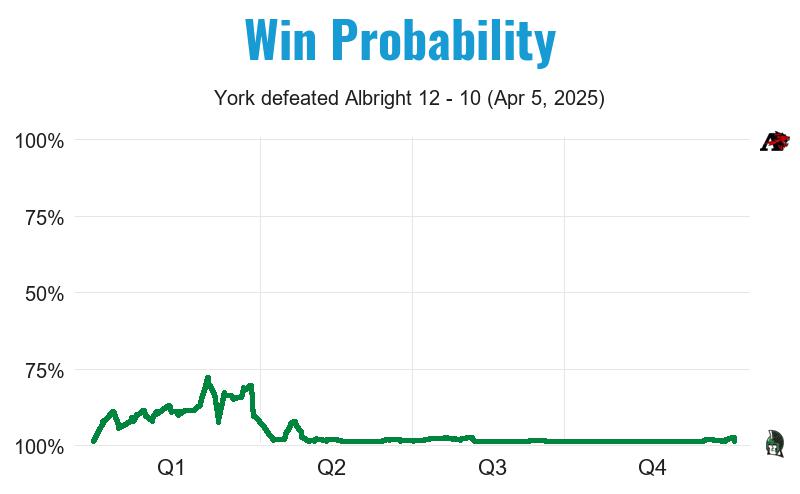
Could it be that the York staff took advantage of the large margin in an uncompetitive game to get their starters some rest and the end of their bench some playing time? I don’t think that this debate should hinge on cherry-picked examples, but I do think that this is a good example of the broader fact that the data that PowerWise is calibrated against on would look very different if PowerWise was already in place.
PowerWise is putting a lot of faith in the “extra signal” that we can glean from goal-differentials. I don’t think that this is an assumption that holds up against actual data.
Why NPI?
So far, I’ve mostly focused on PowerWise and the risks I see if it were to be adopted. I’ve written in the past about the pros and cons of NPI, but it’s always been in contrast to the status quo. So let’s spend some time talking about how NPI stacks up against PowerWise.
First and foremost, NPI gets rid of the RPI system too. The penalty incurred by beating a weak opponent is gone in NPI just as much as it is under PowerWise. As I mentioned above, NPI managed to put the same teams into the tournament as the committee did, but with no committee and no RPI. To the degree that a benefit of PowerWise is that it means we can move away from RPI, well NPI does that too, but it does it without requiring any sort of margin-of-victory incentive.
Similarly, the article linked above mentioned the 2019 High Point team as a team that should have been given a better shot at an at-large. The implication is that PowerWise would have allowed for this (although I’m not sure what the 2019 PowerWise ranking would have looked like). If we had had NPI in place in 2019, High Point would have been ranked 8th. If NPI was in place last year, Army would have been dancing and Richmond would have gotten a home game in the first round. NPI has proven itself to be more even-handed toward lower-conference teams with strong resumes. (As I mentioned above, this is using the DIII weights; if we adopted NPI, we would need to calibrate the settings to each new division.)
Two of the main benefits cited in the article are also benefits that we’d get with NPI. And, crucially, we would not have to deal with the margin-of-victory incentive.
Why not NPI?
There is also a recently published paper out there with 2 critiques of the NPI system: one technical and one that appears to be a misunderstanding.
One critique is that the dials used in the NPI system are subject to a committee. I believe the implication is that a committee might change the dials during the season for some reason. This is a misunderstanding of the NPI process; in the two years it has been in operation, the dials have not moved. The NCAA documentation on NPI is clear that the dials are only subject to change every two years and as part of the annual off-season meetings. If NPI were subject to a committee that could change the dials at their discretion, I would never support that system. Transparency and objectivity are the two main reasons to go to an algorithm.
The second critique is that NPI could theoretically be unstable and produce a different outcome from one run to another on the same set of games. I am not smart enough to verify that this is true, so I’ll take the word of the authors that it’s technically possible. I can say though, that in two years of calculating NPI for all 6 divisions of college lacrosse, I have never seen this happen.
And to the extent that the authors have identified a combination of results and dials that has produced this phenomenon, I think it would be helpful to share it with the NCAA so that they can confirm that the system currently in use in Divisions II and III is robust against this possibility. If they don’t already have something in place to handle this, it would be trivial to add a simple tie-breaker rule for the extremely rare circumstances that this actually happens.
Take my opinion with a grain of salt if you must, but I don’t think either of these critiques is a serious reason to avoid NPI.
On the leap into the unknown
I’m not even really sure what happens next. Is this something the coaches vote on? Do coaches get a say or is this something the NCAA handles on their own? Who is arguing for NPI?
Either way, I have had a few people ask my opinion of the system and I thought it would be useful to share my thoughts. Like I said at the top, I think PowerWise would be an improvement over the committee-based status quo. But NPI exists! And it has a lot of benefits with less of the risks. And it’s already in use.
So what really prompted me to write this piece is that the USA Lacrosse article included statements that implied that this was happening and it was a foregone conclusion. I don’t know what the process is here, but I love college lacrosse and it made me sad to think that such a momentous decision might be made in a rushed manner without clearly considering the arguments for and against.
NPI has shown itself to be an effective way to identify at-large teams and if anyone asked me what system we should use, then I think a DI-version of NPI is the answer. I’m not sure if this is needed, but let’s slow down and really think about this.
Expected Goals Newsletter
This was originally published in our daily newsletter, Expected Goals, on May 5th. If you want to get more coverage and analysis like this, straight in your inbox every morning, sign up here. It’s free and over 1,300 other lacrosse folks have signed up.


