Roster Analysis: Ursinus MLAX
Ursinus goes into 2026 looking a lot more like a “tweak and improve” group than a “tear it down and rebuild” one. The roster has plenty of familiar names, most of the core production is back, and the staff isn’t staring at massive question marks in goal or on offense. The main unknowns are whether they can replace a key initiator, tighten up the efficiency of the guys who already shoot a lot, and patch the holes in the faceoff unit well enough to get back to the stronger seasons they were putting together not long ago.
Offensively, Ursinus is in a pretty stable spot. They return 82% of last year’s offensive production by EGA, which is a healthy number for a group that finished in the 59th percentile nationally in opponent‑adjusted offense. The biggest loss is clearly Christopher Pucciarelli, who accounted for 21% of the team’s assists and 17% of the total offensive EGA. He was one of the main initiators, and that usage is hard to just plug-and-play. That said, his individual efficiency was only in the 56th percentile, so the impact of losing him is a bit of a swing factor. If the new primary initiator can create similar volume at a higher efficiency, the overall offense could actually tick up. If the ball sticks or the new looks are less dangerous, you could see some slippage.

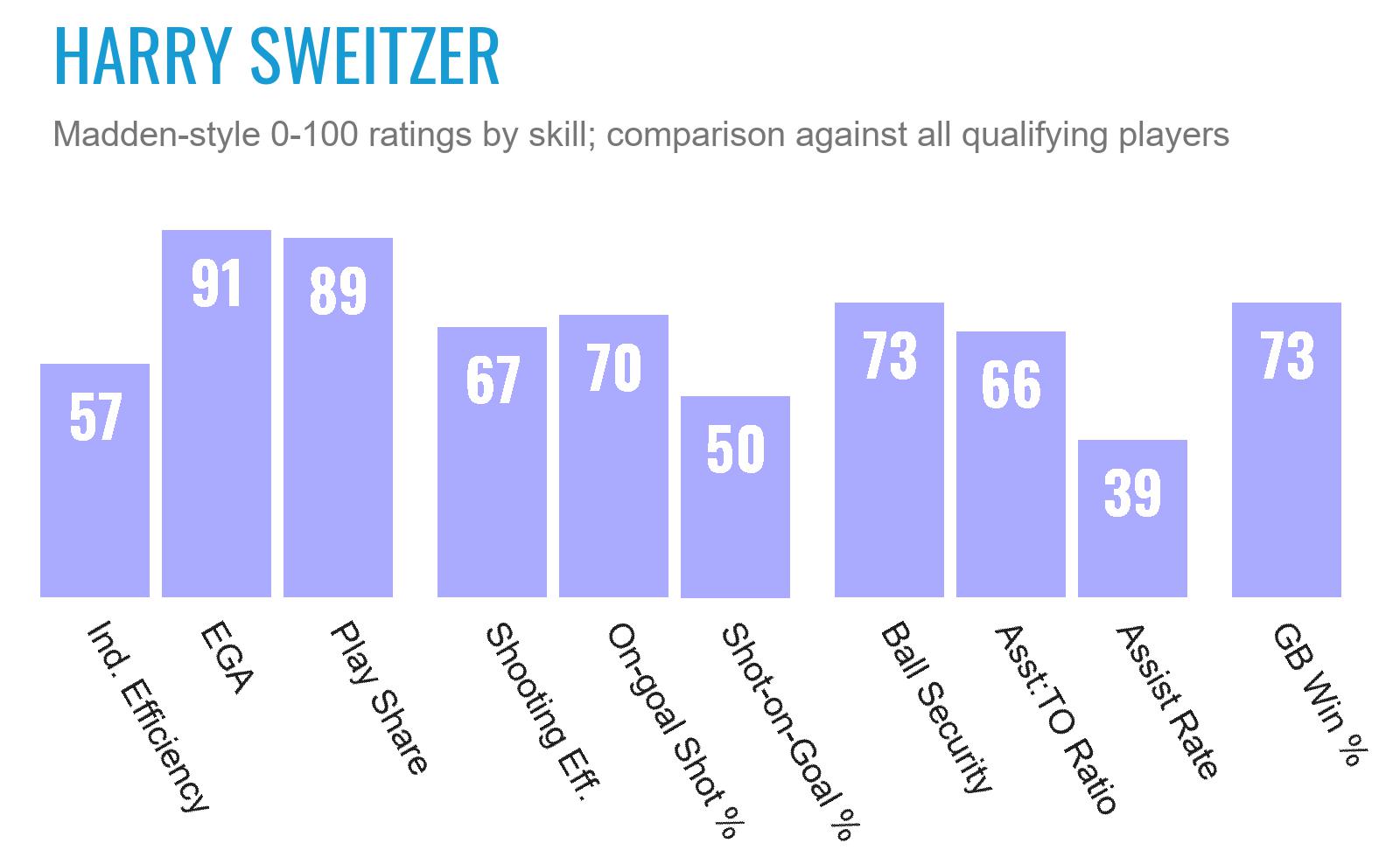
The good news is that the finishing core is intact. Harry Sweitzer returns after taking 19% of the team’s shots and posting per‑game production in the 91st percentile nationally. That’s true top‑end output, and with an individual efficiency in the 58th percentile, he was more than just a volume gunner. If he can hold that usage and nudge the efficiency up a bit, he’s the kind of piece you can center an attack around. Around him, Barrett Denlinger and Daniel Rice give Ursinus a pair of proven complementary options. Denlinger took 10% of the shots and put up per‑game production in the 52nd percentile, but his efficiency lagged in the 36th percentile; the role is valuable, but there’s room for him—or someone in that slot—to squeeze more out of those touches. Rice, with 12% of the shots, had per‑game production in the 59th percentile and efficiency right at the 50th percentile. Between those three, you’ve got a large share of last year’s shooting and EGA back, which is why the 82% returning production number matters: the core identity of the offense should look familiar. The key question is who steps into Pucciarelli’s initiator role and whether that player can keep the ball moving without dragging down the unit’s overall efficiency.
On the other end, Ursinus looks very settled in goal, and that’s not something every program can say. They return 100% of their saves from last season, with Colin Daroch having made 160 saves at a 47% save rate. That’s a solid baseline, and year‑to‑year continuity at goalie usually pays off in better communication and fewer soft spots in the defense. The staff also has options behind him: freshman Andrew Matulevicius comes in, and Zach Lewis is in the room as well. But with no transfer keepers and Daroch carrying all of last year’s game reps, it’s reasonable to expect he’ll get the first shot at the job. Just as important, he won’t be staring at a brand‑new group in front of him. Ursinus returns 71% of their defensive contributions from last year, measured by games played by defenders, so this is not a green unit learning on the fly. An experienced goalie paired with a largely intact defense is usually a recipe for at least steady, if not improved, performance on that side of the ball.
The biggest structural change is at the faceoff stripe. Ursinus brings back 76% of its faceoff experience, which means they’re losing a meaningful chunk of reps and some depth. The headline departure is Dominic Nottoli, who took 81 faceoffs, won 49.4% of them, and was rated the 225th‑best faceoff specialist in the country. That’s a solid second option, and losing him isn’t so much about replacing a star as it is about replacing a reliable part of a platoon. The primary option, Nils Updale, is back after taking 233 faceoffs, winning 54.1%, and earning a rating as the 156th‑best FOGO nationally. Those are good numbers and a big reason the unit finished in the 64th percentile in opponent‑adjusted faceoff win rate—again, solid but not elite. The question is what happens behind him. Cole Mogensen took 79 draws, but with a 27.8% win rate and a rating at 438th nationally, that role either has to improve or shrink. If Updale can handle a bigger share of the load without wearing down, the unit might look similar to last year. If they need to lean heavily on a secondary option and that efficiency doesn’t improve, this is an area where Ursinus could feel some real slippage.
Putting it all together, this roster looks more like one that should bounce back than one set up for a step backward. You’ve got a returning offensive core from a 59th‑percentile attack, a goalie with a full season of experience and 100% of last year’s saves in the bank, and a defense that brings back 71% of its game appearances. The main pressure points are replacing Pucciarelli’s initiation and making sure the faceoff group doesn’t slide from “solid” to “problem.” If a new or improved initiator emerges and the staff can keep the faceoff efficiency near last year’s 64th‑percentile level, the pieces are here for Ursinus to move back toward the stronger seasons the program has gotten used to, rather than repeating a disappointing year.
Expected Goals Newsletter
This was originally published in our daily newsletter, Expected Goals, on Feb 13th. If you want to get more coverage and analysis like this, straight in your inbox every morning, sign up here. It’s free and over 1,300 other lacrosse folks have signed up.
More from the Expected Goals Newsletter
-
Roster Analysis: Morrisville: Dunton gives Morrisville a real backbone in goal, even as questions pile up in other areas
-
Sewanee vs Albion: From 17.8% to a six-goal win: how Sewanee’s defense-held line while the offense flipped the game
-
Colorado College vs Aurora: How a faceoff edge quietly turned Colorado College’s opener from contested matchup into controlled win
-
Bridgewater vs Piedmont: How a team that coughed it up 42% of the time last year just played a game at 5.9% — and what that says about Bridgewater’s new identity.
-
Muskingum vs Wabash: How Muskingum turned Wabash’s offense into just 0.71 shots per possession — better than in any game they played last year
-
William Peace vs Earlham: A routine win on the scoreboard, a potential turning point in goal — was this just Earlham, or the first sign Peace’s biggest weakness is changing?
-
Roster Analysis: RIT: As RIT reloads on offense, the season may hinge on whether Harkins and Bullock can scale up their roles
-
Saint Mary: Saint Mary’s defense tightened the screws, turning a close matchup into a game that never really felt in doubt
-
Roster Analysis: Sewanee: With so much back on offense, Sewanee’s season may hinge on how quickly the defense comes together
P.S. What did I miss? Data-centric analyses like this can miss things that don’t show up in the stats (i.e. injuries/coaching changes). If you can help explain any of the above, put it in the comments.


