Roster Analysis: High Point MLAX
High Point goes into 2026 looking a lot like a solid program that’s trying to turn “pretty good” into something more consistent. The Panthers finished last year with an offense in the 50th percentile nationally (opponent-adjusted) and a faceoff unit in the 86th percentile, which is usually a recipe for being in most games. The big question is whether the current roster nudges them up a tier or keeps them roughly in the same neighborhood.
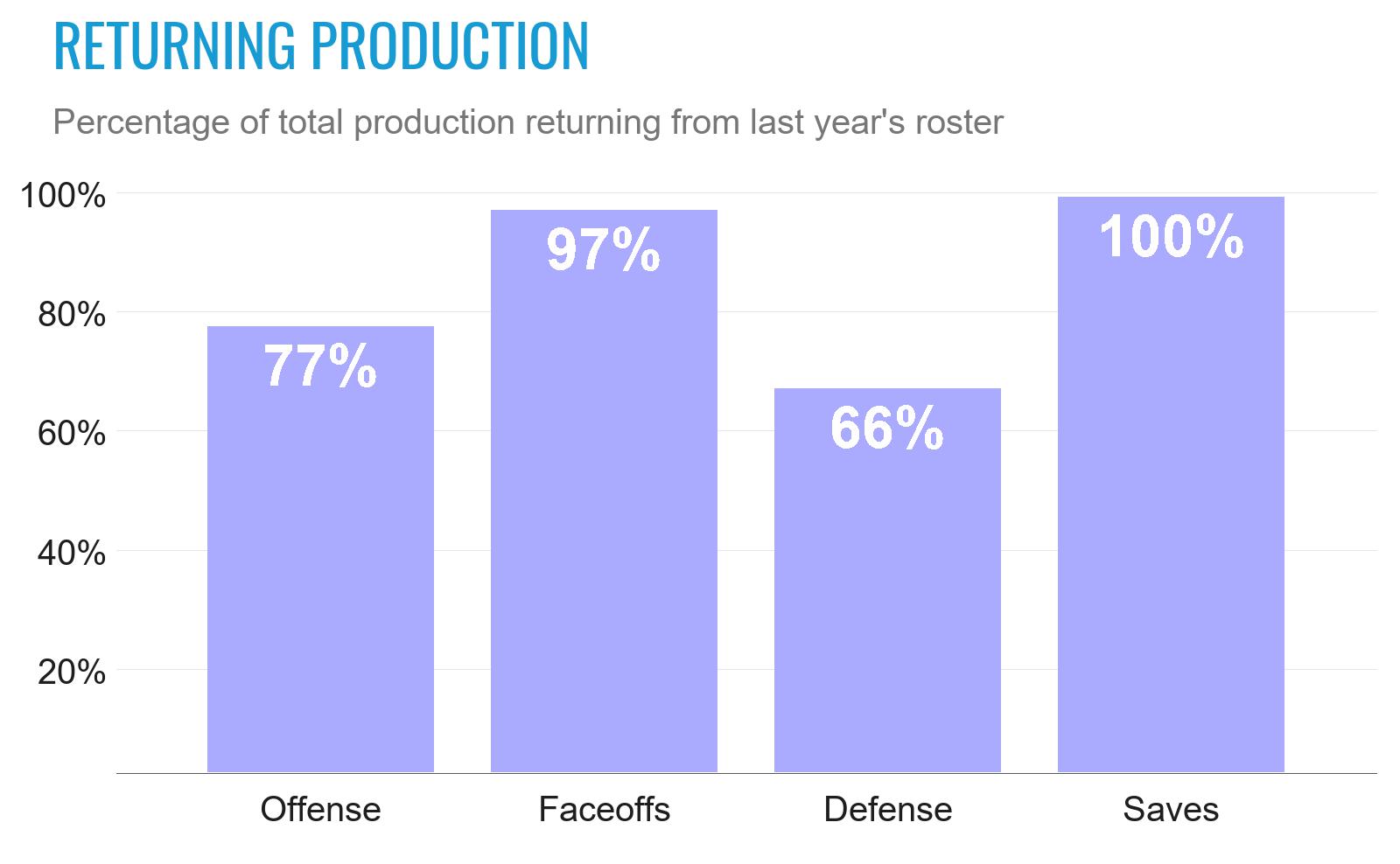
On the faceoff side, this roster sets them up very well. High Point returns 97% of their faceoff experience, which is about as stable as it gets. The centerpiece is Luca Accardo, who took 349 faceoffs, handled 87% of the team’s draws, and won 61.9% of them. That win rate helped him grade out as the 5th best faceoff specialist in the country and drove that 86th-percentile, opponent-adjusted faceoff win rate for the unit as a whole. When you bring back almost all of that volume and quality, you’re starting every game with a built-in possession advantage. There’s always some risk that opposing staffs adjust to him, but the baseline here is very strong, and there’s no obvious reason to expect a big drop-off at the X.
The roster itself is a bit leaner than last year: 52 players in 2026 compared to 58 a season ago. At 52, it’s still a normal-sized group, but the staff will have slightly fewer combinations to tinker with, especially in the bottom of the depth chart. For a team that already has clear anchors at faceoff and in goal, that might not be a bad thing; it can clarify roles more quickly. The flip side is that injuries or underperformance at a couple of spots could force younger or less-tested players into bigger minutes faster than ideal. For a program like High Point that’s trying to climb, that narrower margin for error is worth keeping an eye on.
In goal, High Point is in a strong position from an experience standpoint. They return 100% of their saves from last season, led by Zack Overend, who made 195 saves with a 54% save percentage. That’s a solid number over a full workload and gives the staff a known quantity to lean on. Behind him, the room includes returners Bryce Hoben and Nick Bounassi plus freshman Owen Corsi. With no transfer goalie coming in, it’s reasonable to expect Overend to get the first shot at the job, with Corsi and the others pushing from behind. The wrinkle is what’s happening in front of them: High Point returns 66% of their defensive contributions, measured by games played by defenders. That means roughly one-third of last year’s defensive “experience” is gone, and the defensive group will be a bit greener. So while the goalie spot itself looks stable, Overend and company may be asked to cover for a defense that’s still figuring itself out, especially early in the season.
Offensively, the picture is similar: mostly stable, with some real upside if efficiency improves. High Point returns 77% of last year’s offensive production by EGA, so the core of what they did on that side of the ball is back. The biggest loss is initiator Colin Cooke, who accounted for 7% of the team’s assists and 7% of their total offensive EGA. That’s not a small hole in terms of usage, but his individual efficiency was in the 11th percentile, which suggests that if a replacement can shoulder similar volume more efficiently, the overall offense could actually benefit. The two key returners here are initiator/feeder Justin Wixted and finisher Owen Bunten. Wixted generated 33% of the team’s assists and had per-game production in the 78th percentile, but his individual efficiency sat in the 34th percentile. Bunten took 21% of High Point’s shots and posted per-game production in the 86th percentile, yet his efficiency was in the 38th percentile. In other words, the ball was in their sticks a ton and they produced, but there was meat left on the bone in terms of converting those touches into value. If either or both can nudge their efficiency closer to even the 50th–60th percentile range, that 50th-percentile offense has room to climb without needing a total overhaul.
Putting it all together, this roster looks like it should at least sustain what High Point did last year, with a decent shot to be slightly better. The faceoff unit is set up to remain a strength, the goalie position is experienced even if the defense in front of it is less so, and the offense brings back a clear majority of its production with obvious candidates for growth in the efficiency column. The roster being six players smaller tightens the margins a bit, but it doesn’t signal a step back on its own. For a solid program on an upward track, this group looks more like a continuation of that climb than a reset—how far they go probably depends on whether the returning offensive core can turn high-usage, middling-efficiency seasons into more polished, high-impact ones.
Expected Goals Newsletter
This was originally published in our daily newsletter, Expected Goals, on Feb 12th. If you want to get more coverage and analysis like this, straight in your inbox every morning, sign up here. It’s free and over 1,300 other lacrosse folks have signed up.
More from the Expected Goals Newsletter
-
Boston U vs Dartmouth: What happens when a team wins big while losing two‑thirds of its faceoffs?
-
Duke vs Vermont: Duke didn’t just blow out Vermont — they quietly posted their safest offensive game in years.
-
Mercer vs VMI: How Mercer turned a faceoff beatdown into a comfortable win once the ball was actually theirs
-
Penn State vs Princeton: Penn State’s offense stalled—but a sudden, drastic jump in goalie play flipped a toss-up into a comfortable win.
-
Robert Morris vs Bucknell: Robert Morris doesn’t fix every flaw, but a lights-out day shooting on cage makes the difference
-
Johns Hopkins vs Towson: New faces, same Blue Jays: how Hobot, DiCicco and Ayers powered a reshaped Hopkins core
-
Virginia vs Colgate: With a huge jump in on-goal shooting percentage, Virginia shows how dangerous its 2026 offense could be
-
Villanova vs Penn State: A huge jump in shooting efficiency powers Villanova’s upset of favored Penn State
-
Holy Cross vs Hofstra: How Holy Cross’s defense turned last year’s weakness in goal into the backbone of an overtime upset
P.S. What did I miss? Data-centric analyses like this can miss things that don’t show up in the stats (i.e. injuries/coaching changes). If you can help explain any of the above, put it in the comments.


