Schedule Preview: Florida Southern WLAX
Florida Southern has lined up one of the toughest slates in the country again, and the numbers back that up. Running their 2026 schedule through simulations using last year’s ratings, the Moccasins land at an average record of 12.7–4.3 over 17 games. Most of those runs cluster around that 12–13 win range, with an average simulated NPI of 62.88. That’s a long way from last year’s 71.16, which was good for No. 1 nationally. In other words: this schedule absolutely keeps them in the postseason conversation, but if they want a similar seed line or profile to 2025, they’re going to have to beat the model by a decent margin. The schedule is hard enough that a 3–4 loss season is “normal” in the sims, not a sign something went wrong.
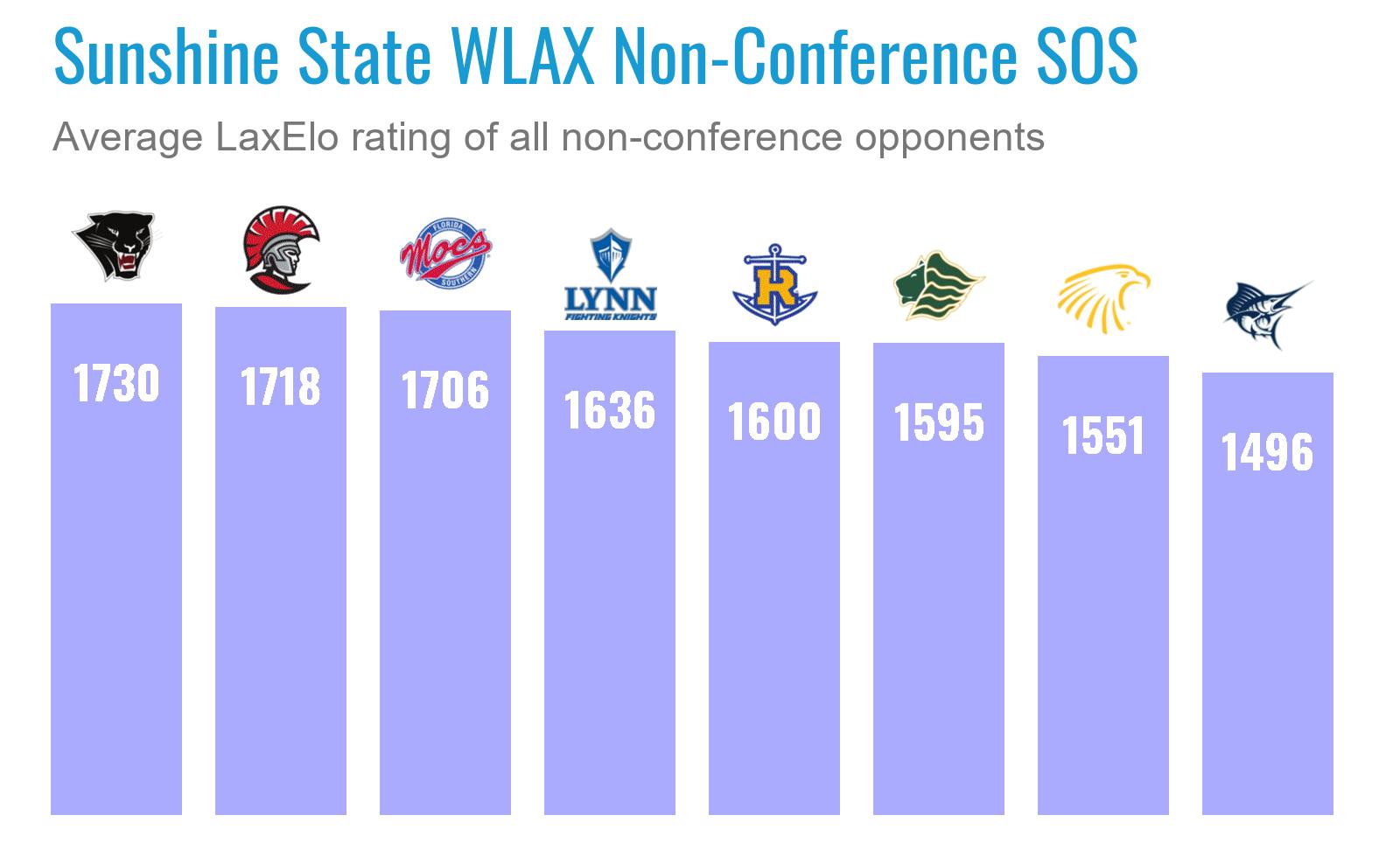
From a strength-of-schedule standpoint, Florida Southern is once again living in the deep end. Using average opponent LaxElo, their overall slate comes in at 2nd nationally; only one team projects to face a tougher path. Last year’s schedule ranked 4th, so this is a modest step up from an already brutal baseline. When you isolate the non-conference piece, they sit 6th nationally based on last year’s opponent ratings. That’s up from 10th a year ago. So the non-conference is a touch softer than the full schedule (2nd vs 6th), but not by much; they’re getting pushed hard both inside and outside the league. For an at-large résumé, that’s exactly what you want: plenty of quality-win chances, and not a lot of dead weight.
Within that framework, the flow of the season matters. The toughest four-game stretch comes from March 25 to April 4: home vs Saint Leo, at Lynn, at Embry-Riddle, and home vs Tampa. Based on LaxElo, the baseline expectation across that run is 2.7 wins. That’s essentially saying 2–2 is the floor of “acceptable,” 3–1 is par, and 4–0 is how you build a No. 1-seed-type résumé. It’s a high-leverage block of games in the heart of the season, and it’s loaded with opponents who can hurt you in the NPI column if you stack losses there.
On the flip side, the softest landing spot is the four-game window from March 5 to March 22: home vs Lander, Dominican (NY), Lenoir-Rhyne, and Maryville. The model pegs that stretch at 3.3 expected wins. That’s the run where you’re “supposed” to bank 3–1 at a minimum and ideally sweep all four. For a team with national-title ambitions, going anything less than 3–1 in that window would put pressure on the rest of the schedule, especially given how unforgiving the late-March/early-April stretch is.
There’s also a grind factor here that doesn’t show up in simple averages. The most demanding block in terms of density is February 26 to March 7: at Flagler, then home vs Regis (CO), Lander, and Dominican (NY) — four games in 10 days. That’s a lot of minutes in a short span, and it comes early enough that depth, conditioning, and how quickly they settle into their rotations will matter. You can’t win a championship in that stretch, but you can absolutely pick up a surprise loss that drags your NPI down.
Compared to 2025, the overall difficulty is similar, but the cast has shifted. Thirteen opponents return from last year’s schedule, and Florida Southern went 14–3 against that group in 2025. That’s a strong base: you know the league, you know most of the non-conference holdovers, and you’ve proven you can win consistently against them. The change comes from the four new faces and the four teams that drop off.
On the incoming side:
– Lenoir-Rhyne: New to the slate, and Florida Southern hasn’t seen them in the shot-clock era. LaxElo gives the Mocs a 92.5% win probability here, so on paper this is one of the more manageable non-conference tests. It still helps the schedule more than a true cupcake would, but this is a game the model expects them to take care of comfortably.
– Wingate: Also new this year, though not a stranger historically. Florida Southern is 6–0 against Wingate in the shot-clock era, including an 18–7 home win on March 2, 2024. The model has this at a 65.4% win probability, which is a noticeable step up in risk compared to Lenoir-Rhyne. It’s the kind of game that won’t kill you if you lose, because Wingate is solid, but it’s also the kind of game that separates a 12-win season from a 14-win season if you hold serve.
– Maryville: Another first-time opponent in the shot-clock era, with a 71.9% projected win probability for Florida Southern. That’s in the “favored but not automatic” tier. It fits the pattern of this non-conference: fewer layups, more games where you actually have to show up and play well to get the expected result.
– Regis (CO): This matchup has some history. Florida Southern is 1–1 against Regis in the shot-clock era, and the last meeting was a 16–14 Regis road win on March 4, 2024. The projection gives Florida Southern a 66.4% chance this time. It is a recent loss to a strong program, followed by a game the model still expects Florida Southern to win about two-thirds of the time. It is the kind of matchup that can swing NPI quickly: defeat a quality team and the rating gains a meaningful boost; lose again, and it becomes a mark against the résumé.
Going out the door are **Lee, Anderson (SC), Mercy, and Pace**. In the shot-clock era, Florida Southern went a combined 9–2 against that group. Recent results were mostly decisive: 17–5 over Lee (road, March 6, 2025), 18–2 over Anderson (home, March 2, 2025), 12–8 over Mercy (home, March 19, 2025), and 20–11 over Pace (home, March 16, 2025). Those were generally favorable matchups; still useful for NPI when those teams were strong, but not as risky as some of the new additions appear to be. Swapping them out for Regis, Wingate, Maryville, and Lenoir-Rhyne nudges the non-conference slate a bit tougher overall, which shows up in the move from 10th to 6th in non-conference SOS.
Big picture, this is exactly the kind of schedule you’d expect from an elite program that expects to be playing deep into May. Overall SOS at 2nd, non-conference SOS at 6th, a simulated record around 13–4, and a most-likely NPI in the low 60s all point to a team that’s set up to make the postseason if they simply play to their level. To get back into that No. 1 NPI neighborhood, they’ll need to squeeze extra wins out of the toughest pockets — especially that March 25–April 4 run — and avoid stubbing their toe in the “should win” windows like March 5–22 and the early-season gauntlet.
Does this schedule give them a good shot at the postseason? Yes. The combination of volume wins in the mid-teens and a top-5 strength-of-schedule profile is almost always enough to get you in. The real question for Florida Southern isn’t “in or out,” it’s where they land on the bracket and whether they can turn a brutal schedule into the kind of NPI they had last year. The path is there; it just doesn’t leave much room for off days.
Expected Goals Newsletter
This was originally published in our daily newsletter, Expected Goals, on Jan 21st. If you want to get more coverage and analysis like this, straight in your inbox every morning, sign up here. It’s free and over 1,300 other lacrosse folks have signed up.
More from the Expected Goals Newsletter
-
Alabama Huntsville vs Anderson SC: The stat that really decided UAH–Anderson: a huge drop in shots allowed per possession
-
Roster Analysis: Alabama Huntsville: Almost nothing is missing from Alabama-Huntsville’s scoring core, giving this offense a rare level of carryover
-
Keys-to-Victory: Another Angle: How to calibrate per-game goals that actually predict winning
-
Roster Analysis: Flagler: As Flagler rebuilds the back end, Wright’s high-end creation keeps the offense in top-tier territory
-
Schedule Preview: Adelphi: From Lynn to Bentley, a four-game run in late winter looms as Adelphi’s biggest test of 2026
-
Roster Analysis: West Chester: Can Wasdick turn big numbers into true go-to-star impact for West Chester in 2026?
-
Roster Analysis: Saint Anselm: A deep roster and proven scorers return, but there’s no easy swap for last year’s anchor in goal
P.S. What did I miss? Data-centric analyses like this can miss things that don’t show up in the stats (i.e. injuries/coaching changes). If you can help explain any of the above, put it in the comments.


