Roster Analysis: Virginia Wesleyan MLAX
Virginia Wesleyan comes into 2026 in an unusual spot: they’re trying to build on a legitimately solid season with a roster that has a lot of holes in key places. Last year’s group was roughly a 27th-percentile offense and a 25th-percentile defense on an opponent-adjusted basis, with a 45th-percentile save percentage and a 42nd-percentile faceoff unit. For a program that’s been toward the bottom nationally in recent years, that represented real progress. The question now is whether this roster has enough proven production and experience to keep that trajectory going, or whether 2025 ends up looking more like a high-water mark.
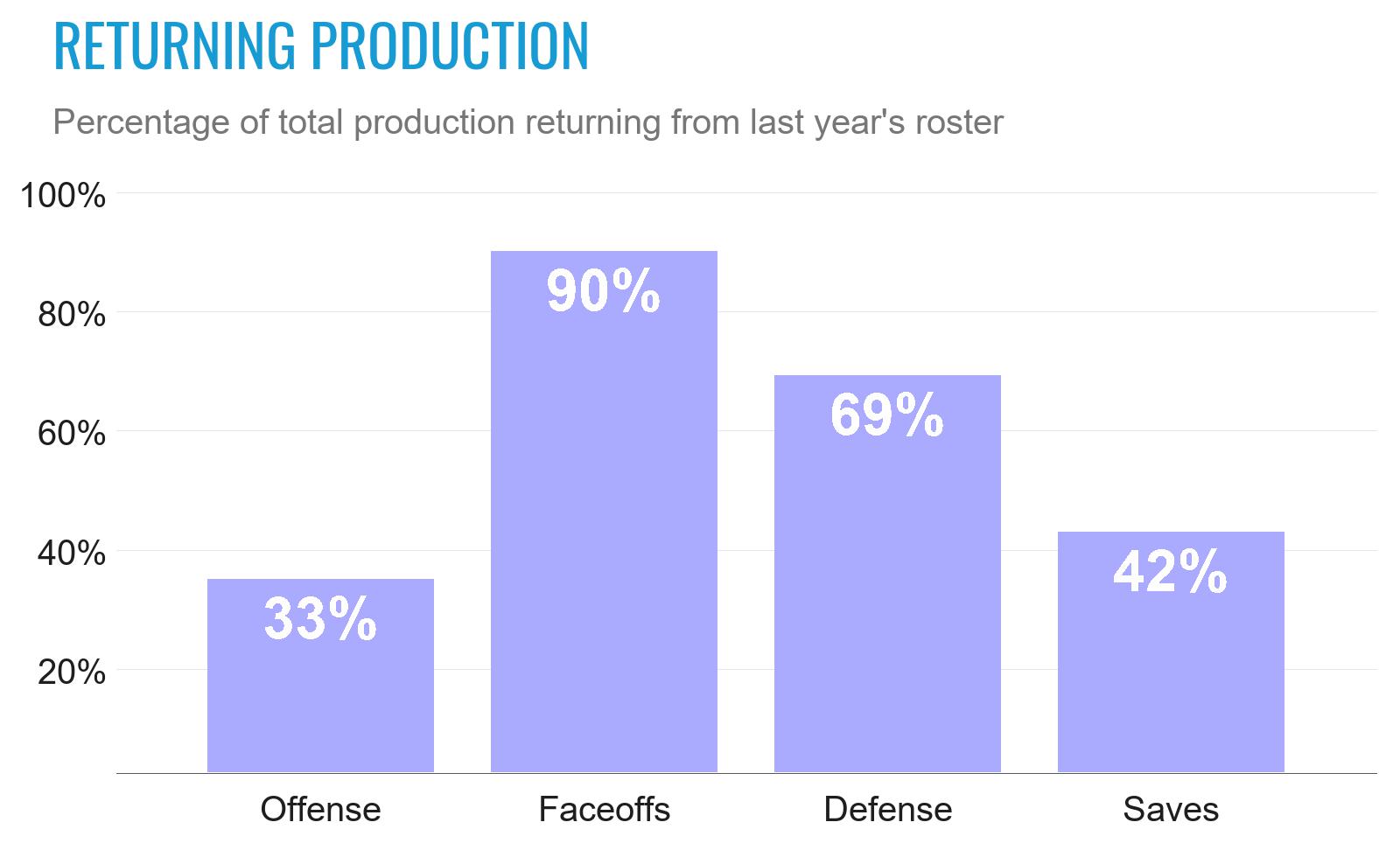
The biggest storyline is the offense, and it’s not subtle: Virginia Wesleyan returns just 33% of its offensive production. That means 67% of last year’s offensive EGA has walked out the door, which is rare at any level. Patrick Ruffolo alone accounted for 14% of the offensive EGA and took 13% of the team’s shots with an individual efficiency in the 62nd percentile. On top of that, they also lose George Psaltis (13% of offensive production), Parker Lucas (16%), and Sebastian Reynolds (11%). That’s more than half the offense gone in just four players, most of them primary shot-takers and initiators. For a unit that was already only in the 27th percentile nationally, this isn’t just a retool; it’s close to a full rebuild.
If there’s a path to keeping the offense afloat, it runs through internal growth. Ben Andrews is the clearest candidate to take on a much larger role. He was in the 79th percentile for total EGA last year with an individual efficiency rating of 68 on a 0–100 scale. He already carried a real load: 14.4% of Virginia Wesleyan’s shots and 10.5% of their assists. Those numbers suggest he wasn’t just a finisher; he had some playmaking responsibility too. If his usage jumps to fill the Ruffolo/Lucas/Psaltis/Reynolds void and he can keep his efficiency in that range, he becomes the focal point of the offense. Liam Murphy is another name to watch. He sat in the 46th percentile for total EGA with an individual efficiency rating of 49. That’s more middle-of-the-pack, but it’s at least a baseline of proven production in a group that doesn’t have much of it. The risk is that players like Andrews and Murphy will be asked to scale up their roles dramatically; when that happens, efficiency can slide. The upside is that if they handle the extra volume and a few newcomers hit, this offense could actually be more balanced and, in theory, more efficient than last year’s top-heavy group. The downside is that if those bets don’t pay off, a 27th-percentile offense could easily slip backward.
Experience is another pressure point. Using the top-10 players as a proxy for the main rotation, the median Virginia Wesleyan rotation player has appeared in 32 career games, and only 6 players on the roster have logged at least 30 career games. That’s not nothing, but it’s not the profile of a veteran-heavy group either. For a team trying to replace two-thirds of its offense and several key defensive pieces, that kind of experience level means more volatility. The ceiling is that some of the less-tested players are better than the guys they’re replacing and the whole thing jumps a level. The floor is that the learning curve is steep and the inconsistency shows up in the win–loss column. Given where Virginia Wesleyan is in its broader program arc, this roster looks more like a transitional group than a “run it back” veteran squad.
In goal, there are more questions than answers. Virginia Wesleyan returns 42% of its saves from last season, so there is at least some continuity, but the raw numbers underline how unproven this room is. The biggest loss is Alexander Patrizi, who made 7 saves with a 64% save percentage. That’s a small sample, but it’s at least evidence of someone who was stopping shots at a strong clip. The most experienced returning keeper is Blake Howell, who made 5 saves last year with a 33% save percentage. He appeared in 3 games, facing 15 shots and stopping 5 of them. On paper, that’s not a lot to hang your hat on for a team that finished in the 45th percentile in save percentage last season. With no experienced transfer coming in, it’s reasonable to assume Howell gets the first chance to start, but that’s far from settled. Freshman goalkeeper Thomas Skelly joins the mix, and the room also includes Aiden Freeland, Alec Gordon, Aidyn Shatarsky, and Jackson Skinner, all essentially unknown at the college level. The range of outcomes here is wide: if one of these goalies seizes the job and plays at or above last year’s 45th-percentile level, the defense has a chance to stabilize. If not, the back end could be a real sore spot.
Defensively, the picture is similar: some continuity in terms of bodies, but key losses where it matters most. By total defensive experience measured in games played, Virginia Wesleyan returns 69% of last year’s defensive experience. That sounds like a reasonably solid base, but the nuance is important. Of the top four defensive players by play share, none are back. They lose Crosson Miller, Carter Dukes, Zack Tucker, and Kevin Velazquez Delgado. For a defense that finished in the 25th percentile, that cuts both ways. On one hand, you’re not breaking up an elite unit; there’s room for improvement if the new core can clean up last year’s mistakes. On the other hand, those were the guys who carried the bulk of the minutes and assignments. Replacing that kind of usage with less-tested players introduces risk, especially when paired with an unsettled goalie situation. The 69% figure suggests there are still plenty of players who have been on the field, but the fact that the heaviest-minute defenders are gone means roles and matchups will likely be shuffled significantly.
At the faceoff X, Virginia Wesleyan at least has a clear anchor. Jeremiah Madriaga returns after taking 83% of the team’s draws last year with a 52% win rate. For a unit that finished in the 42nd percentile in opponent-adjusted faceoff win rate, that’s a pretty solid individual platform to build on. They do lose Jacob Carroll, who took 11% of the draws, and they are not adding any experienced transfer specialists, so depth behind Madriaga is more of an open question. But having your primary draw man back, with that kind of volume and a slightly above-50% win rate, is one of the more stable pieces on this roster.
Putting it all together, this Virginia Wesleyan roster looks like one that’s fighting uphill to match last year’s step forward. Losing 67% of offensive production, all four of your top defensive play-share guys, and having an unproven goalie room is a lot to overcome in one offseason, especially for a program still trying to establish itself. The counterweight is that there are a few clear building blocks: Andrews as a potential offensive centerpiece, Murphy as a secondary option, Madriaga at the X, and a decent amount of defensive experience in aggregate even if the top-minute guys are gone. The lack of experience and proven production means the range of outcomes is wide. If the younger players and newcomers are ready, Virginia Wesleyan could roughly hold serve and keep the upward trend alive. If they’re not, this roster more likely points to a season where they take a step back before they can move forward again.
Expected Goals Newsletter
This was originally published in our daily newsletter, Expected Goals, on Jan 20th. If you want to get more coverage and analysis like this, straight in your inbox every morning, sign up here. It’s free and over 1,300 other lacrosse folks have signed up.
More from the Expected Goals Newsletter
-
Schedule Preview: Gettysburg: How a single Saturday in march can move Gettysburg’s non-AQ at-large odds by nearly 30 percentage points
-
Roster Analysis: Centenary (LA): Can Harvill turn solid numbers into true go-to production for Centenary’s rebuilt offense?
-
Keys-to-Victory: Another Angle: How to calibrate per-game goals that actually predict winning
-
Roster Analysis: Illinois Wesleyan: With most of the offense gone, is this the year Illinois Wesleyan breaks through or slides back to average?
-
Schedule Preview: Christopher Newport: New names, same gauntlet: how a modestly tougher schedule could reshape CNU’s postseason résumé
P.S. What did I miss? Data-centric analyses like this can miss things that don’t show up in the stats (i.e. injuries/coaching changes). If you can help explain any of the above, put it in the comments.


