Schedule Preview: West Chester WLAX
West Chester did not ease back into the national picture with this schedule; they returned decisively. By the numbers, this is among the most challenging schedules in the country, and the non-conference portion in particular represents a significant increase in difficulty from last year. If the question is whether this schedule provides a strong chance to make the post-season, the answer is yes; it also raises the standard for how well they will need to play.
We begin with the simulations. Over 17 games, West Chester projects to 13.9 wins and 3.1 losses, equivalent to roughly a 14–3 season. Carrying forward last year’s NPI ratings for each opponent, the most common outcome places them at an NPI of about 61.95. That is solid in the national picture, but it represents a decline from last year’s 66.36, which ranked fifth nationally. Put differently, if they simply meet the baseline projections, they are more likely to finish with a slightly weaker tournament résumé than in 2025. To match or exceed last year’s NPI, they will need to outperform the simulations—win a couple of toss-up games and avoid damaging losses.
When you stack this schedule up against last year’s, the continuity is actually pretty high on paper: 14 of last year’s 16 opponents are back on the docket, and West Chester went 14–0 against that group in 2025. The real change is in who got added and who dropped off. Coming in: Slippery Rock, Adelphi, and Pace. Going out: American International and Roberts Wesleyan.
That trade is where the difficulty spike really shows up. Slippery Rock is a solid add (West Chester’s got about an 81% win probability there), but Adelphi and Pace are the big swing pieces. The Rams are basically in coin-flip territory with both—roughly 55% against Adelphi and 54% against Pace. Compare that to American International and Roberts Wesleyan, who they’ve hammered historically and who dragged last year’s non-conference numbers down. Those two exits take away games where West Chester was heavily favored and replace them with matchups that could go either way and that carry much more weight in NPI. Put simply: last year’s non-conference schedule was forgiving; this year’s is built to test them.
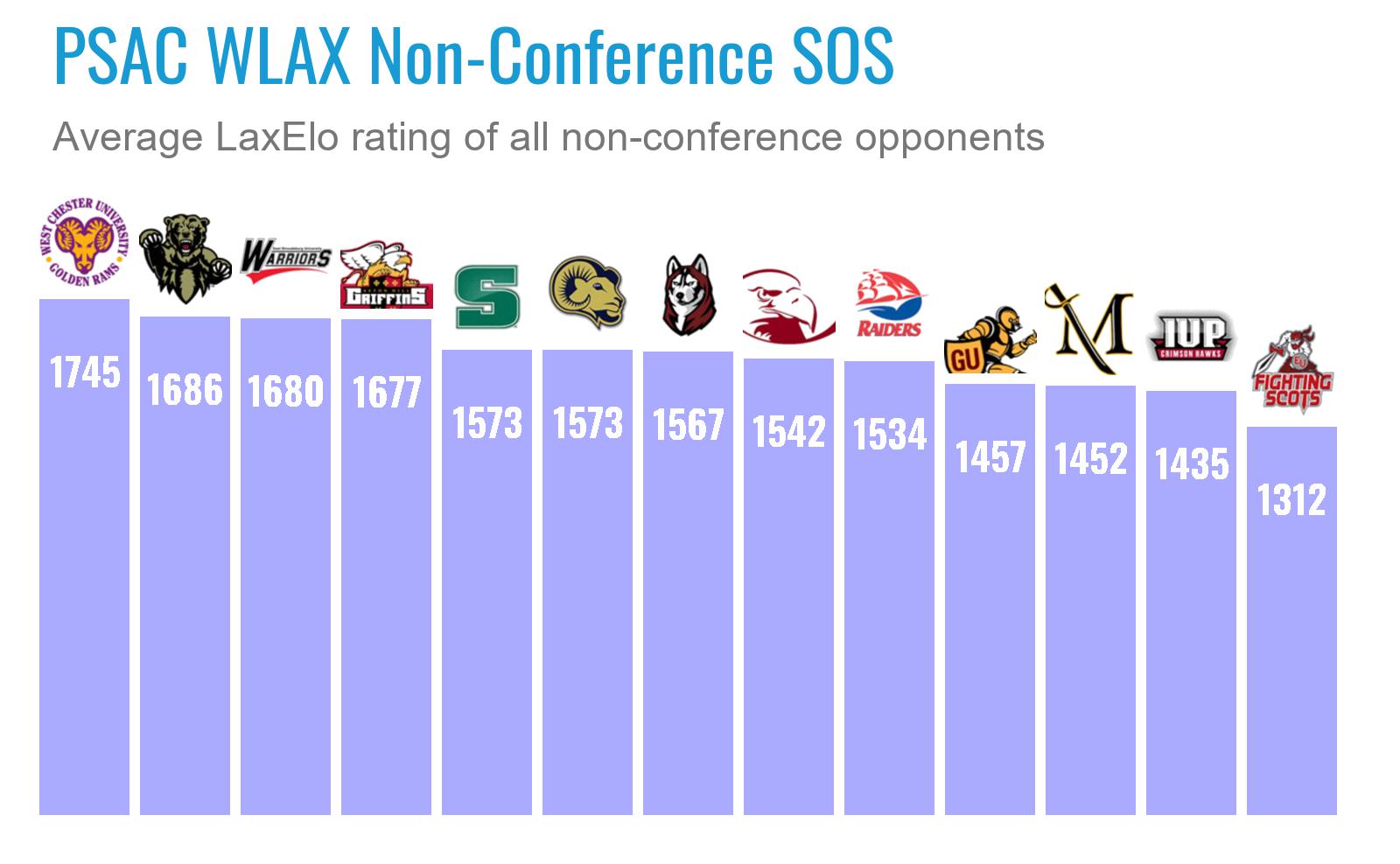
The strength-of-schedule rankings back that up. Overall, West Chester’s 2026 schedule grades out as the 11th-toughest in the country based on average opponent LaxElo. Last year’s overall slate ranked 31st. So they’ve jumped from “solid but not brutal” to “top-tier grind” in one offseason. The non-conference piece is even more aggressive: the 2026 non-conference SOS ranks 3rd, compared to 38th a year ago. That’s a massive move. Coaches don’t control everything about who’s available to play, but however this came together, the end result is a non-conference lineup that can absolutely anchor an at-large résumé if they win enough of those games. The conference slate, meanwhile, didn’t move much—so the jump in difficulty is really being driven by that out-of-league upgrade.
Within the schedule, there are a few stretches that could shape how the season unfolds. The toughest four-game run spans February 28 to March 12: at Adelphi, home against Millersville, at Pace, and at Bentley. Based on opponent strength, West Chester’s expected result in that stretch is about 2.8 wins. That suggests two things: first, there is no clear mismatch in that stretch; second, going 3-1 is roughly in line with expectations, while 4-0 would be a strong signal that they are back among the elite. At 2-2 or worse in that span, they would be behind in both NPI and perception.
On the flip side, the softest four-game window runs from April 15 to April 25: home vs Shepherd, at Bloomsburg, home vs East Stroudsburg, and home vs Shippensburg. The baseline expectation there is 3.6 wins out of 4. That’s the stretch where you absolutely have to stack results. Anything less than 3–1 would sting, and going 4–0 is what a true national contender should be aiming for, especially with three of those four at home. How they navigate those two segments—surviving the early gauntlet and cashing in on the April run—will go a long way toward deciding whether they’re fighting for seeding or just fighting to be on the right side of the bubble.
The last piece of this, and it matters a lot with a schedule this strong, is the ripple effect from everyone else’s games. If West Chester doesn’t win the automatic qualifier, their at-large profile is going to be heavily shaped by two things: how good their opponents look in the computers, and how many bubble rivals stumble. This year, there are a lot of games where the Rams have a real rooting interest. The Ashland example is a clean way to see it. There are two Ashland games that noticeably move West Chester’s non-AQ NCAA odds: Ashland vs Slippery Rock (Feb 18) and Ashland vs UIndy (Mar 1). When Ashland wins those, it boosts the quality of West Chester’s schedule and chips away at a potential at-large rival at the same time. One game, two different résumé benefits.
March 7 is the big circle-on-the-calendar day for this kind of scoreboard watching. On that date alone, there are five games where the outcome shifts West Chester’s non-AQ probability by a meaningful amount: Shippensburg over Frostburg State (+3.2 percentage points), Bloomsburg over Wilmington (+2.5), D’Youville over Slippery Rock (+2.2), East Stroudsburg over Adelphi (+2.2), and American International over Coker (+1.7). If every one of those results broke West Chester’s way, the model says their at-large chances would sit about 12 percentage points higher than if every one went the other direction. That’s not a prediction that everything will line up perfectly—just a way of showing how sensitive their profile is to results they’re not directly involved in.
Put it all together, and this is exactly the kind of schedule you build if you’re an elite program trying to bounce back from a “good but not great” year. It gives them a very real path to the postseason and a high ceiling if they hit their stride, but it also leaves very little room for a bad week or two. The upside is clear: with an 11th-ranked overall SOS and a top-3 non-conference slate, if West Chester plays to its potential and lands north of that 61.95 NPI projection, they’re going to look like a serious at-large team even if they don’t grab the AQ. The downside is just as clear: underperform the projections, and this schedule will punish them in a hurry. This year is going to tell us a lot about whether the Golden Rams are ready to climb back into that true national-title-contender tier.
Expected Goals Newsletter
This was originally published in our daily newsletter, Expected Goals, on Jan 16th. If you want to get more coverage and analysis like this, straight in your inbox every morning, sign up here. It’s free and over 1,300 other lacrosse folks have signed up.
More from the Expected Goals Newsletter
-
Roster Analysis: Saint Anselm: A deep roster and proven scorers return, but there’s no easy swap for last year’s anchor in goal
-
Schedule Preview: Florida Southern: The season hinges on a brutal four-game gauntlet where even 3–1 only keeps Florida Southern on pace
-
Schedule Preview: Tampa: Familiar foes return, but Wingate’s arrival gives Tampa’s non-conference schedule some extra weight
-
Roster Analysis: Rollins: With key scorers gone, can Hudson’s playmaking and Bell’s efficiency keep rollins near the top offensively?
P.S. What did I miss? Data-centric analyses like this can miss things that don’t show up in the stats (i.e. injuries/coaching changes). If you can help explain any of the above, put it in the comments.


