Schedule Preview: North Carolina WLAX
North Carolina didn’t exactly ease off the gas with this 2026 slate. Top to bottom, this is one of the toughest schedules in the country, and the big story is how much they’ve cranked up the non-conference compared to last year. When you run it through the simulations, you get a team that’s still clearly in the national title conversation, but with a much thinner margin for error if they want to match or beat last year’s résumé.
Based on last year’s ratings carried forward, the Heels project to go about 11.4–3.6 over their 15 games. That is the profile of a clear postseason team, and in most simulations, they end up with an RPI somewhere in the 3–11 range. For context, last year’s group finished No. 1 in RPI, so the model indicates that this schedule is very challenging; even a very strong season is more likely to place them in a roughly top-10 range rather than at the very top. To return to No. 1, they would need to outperform those projections, either by winning a few more toss-up games or by turning some “probable wins” into decisive results that improve the numbers.
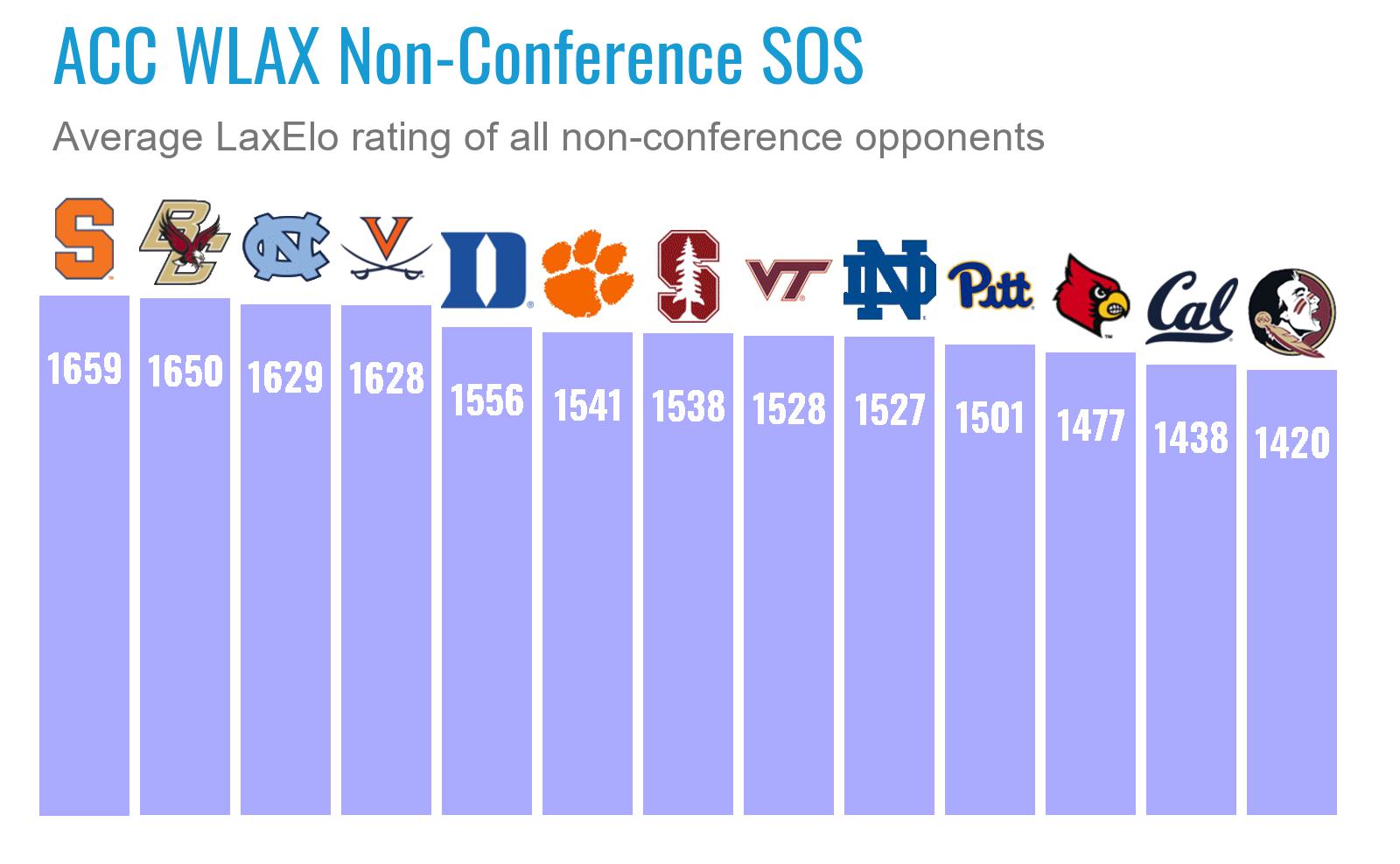
The strength-of-schedule metrics back up what you see on paper. If you look at the average LaxElo rating of all their opponents, North Carolina’s overall schedule comes out 2nd nationally, after ranking 4th last year. That’s already a brutal grind. But the non-conference piece is where things really jump: their non-conference strength-of-schedule ranks 1st, compared to 16th a year ago. In other words, last season they were still elite overall, but part of that came from an ACC gauntlet paired with a more forgiving non-conference slate. This year, there’s nowhere to hide. The games they control the most—the non-conference—are now the toughest set anyone played in last year’s data.
When you line this schedule up against 2025, you see a lot of continuity with a few key swaps that raise the difficulty. Of the 15 opponents from last season, 11 are back, and North Carolina went a perfect 16–0 against that returning group in 2025. That’s a strong base of familiar matchups where they’ve already proven they can take care of business. The changes come at the margins. Florida State, Pittsburgh, Ohio State, and Stanford are new to the 2026 slate. LaxElo has UNC as heavy favorites over Pitt (96.5% win probability) and Ohio State (96.2%), and still clearly favored against Stanford (85.8%). Florida State is the wild card: they’re new this year, and their rating is set to the default 1500, which is almost never exactly right for a first-year program, so that adds some noise to the projections.
On the flip side, Temple, Virginia Tech, Liberty, and Notre Dame fall off the schedule. Historically, UNC has dominated that group, going 15–2 in the shot-clock era, including blowout wins over Temple (19–3 in 2025) and Liberty (23–1 in 2025), plus a 19–9 win over Virginia Tech and a 14–3 road win over Notre Dame last season. Swapping out opponents they’ve routinely handled for a new mix that includes a tougher non-conference profile is a big part of why the non-league SOS jumps from 16th to 1st. The ACC portion stays about as nasty as usual, but the non-conference no longer offers as many “comfortable” games.
If you zoom in on the calendar, there are a couple of stretches that really stand out. The toughest four-game run comes from March 12–25: at California, then home against Florida, Boston College, and Northwestern. That’s a stretch where the baseline expectation from the model is 3.1 wins. So, on average, you’re looking at something like 3–1 through that run, with a small chance they sweep it. That’s the kind of segment that will define their RPI ceiling; go 4–0 there and you’re right back in the mix for a top-two seed, go 2–2 and you’re probably living in that 5–10 range.
On the other end, the “easiest” four-game block, at least on paper, comes early: February 13–27. They go to Syracuse, then host Ohio State, Louisville, and Florida State. Even in the “easy” stretch, you’ve still got a road ACC game to start it off, which tells you how strong the overall slate is. The model pegs that run at 3.8 expected wins, so basically anything less than 3–1 would be underperforming expectations, and 4–0 is very much on the table. If they bank wins there, it gives them some cushion heading into that brutal mid-March gauntlet.
There’s also a grind factor to consider. From March 17–28, they play Florida, Boston College, Northwestern, and East Carolina—all at home—but that’s four games in 12 days. The opponents are strong and the turnaround is tight, so depth and health will matter. For a program with championship ambitions, that’s the kind of stretch that tests whether you’re just good, or truly built to handle a May-style workload.
Bottom line, this schedule absolutely gives North Carolina a strong shot at the postseason and keeps them squarely in the championship hunt. The simulations say they’re likely to finish with a double-digit win total, a top-10 RPI, and plenty of quality wins on the board. Whether they can repeat or improve on last year’s No. 1 RPI finish will come down to how they navigate those tougher non-conference matchups and that mid-March stretch.
One last caveat: because Florida State is new, their LaxElo rating is set to the default 1500, which is almost certainly off to some degree. That uncertainty trickles into the strength-of-schedule numbers and the win projections, so the SOS rankings and expected record for UNC come with a little more wiggle room than usual.
Expected Goals Newsletter
This was originally published in our daily newsletter, Expected Goals, on Jan 16th. If you want to get more coverage and analysis like this, straight in your inbox every morning, sign up here. It’s free and over 1,300 other lacrosse folks have signed up.
More from the Expected Goals Newsletter
-
Roster Analysis: Maryland: Maryland leans on a battle-tested core, not a youth movement, as it eyes a jump toward contender status
-
Roster Analysis: Yale: Yale’s defense is built to contend, but the season hinges on whether new scorers can grow up fast
-
Schedule Preview: UMass: A softer slate means fewer chances to move the needle, even if the win total looks pretty good
-
Schedule Preview: Yale: A softer non-league slate boosts expected win totals but may make a top-tier tournament seed tougher to grab
P.S. What did I miss? Data-centric analyses like this can miss things that don’t show up in the stats (i.e. injuries/coaching changes). If you can help explain any of the above, put it in the comments.


