Roster Analysis: Yale WLAX
Yale’s 2026 roster has a very different shape than the group that just finished a strong season. The headliner is how much proven production has walked out the door, especially in the draw circle and on offense, while goalie and much of the defense remain relatively intact. With 30 players listed—down from 38 last year and on the smaller side nationally—the margin for error is thinner, but the core that remains is tied to a defense that finished in the 90th percentile on an opponent-adjusted basis. The big question is whether that defensive backbone and returning goalie experience can cover for an offense and draw unit that are basically starting from scratch.
The draw-control situation is about as close to a reset as you’ll see at this level. Yale returns just 5% of its draw-control experience from last season, which is extremely rare for a team that was this good on the circle. Last year’s unit ranked in the 94th percentile nationally in opponent-adjusted draw-control win rate, and a lot of that edge came from players who are no longer on the roster. The biggest loss is Jenna Collignon, who posted 90 draw-control wins and 19.0 total draw-control-related EGA last season, putting her in the 97th percentile for draw-control-related production (fEGA). On top of that, Taylor Lane and Sky Carrasquillo both leave with career draw-control totals in the 99th percentile—238 and 260 career draw-control wins, respectively. When you add in Collignon’s 273 career draw-control wins (also in the top percentile), you’re talking about three career-level elite draw specialists gone at once. That’s not just a talent drain; it’s a total identity change on the circle. Whoever steps in is inheriting a unit that has been operating at a near-elite national level, with almost no returning in-game experience to lean on.
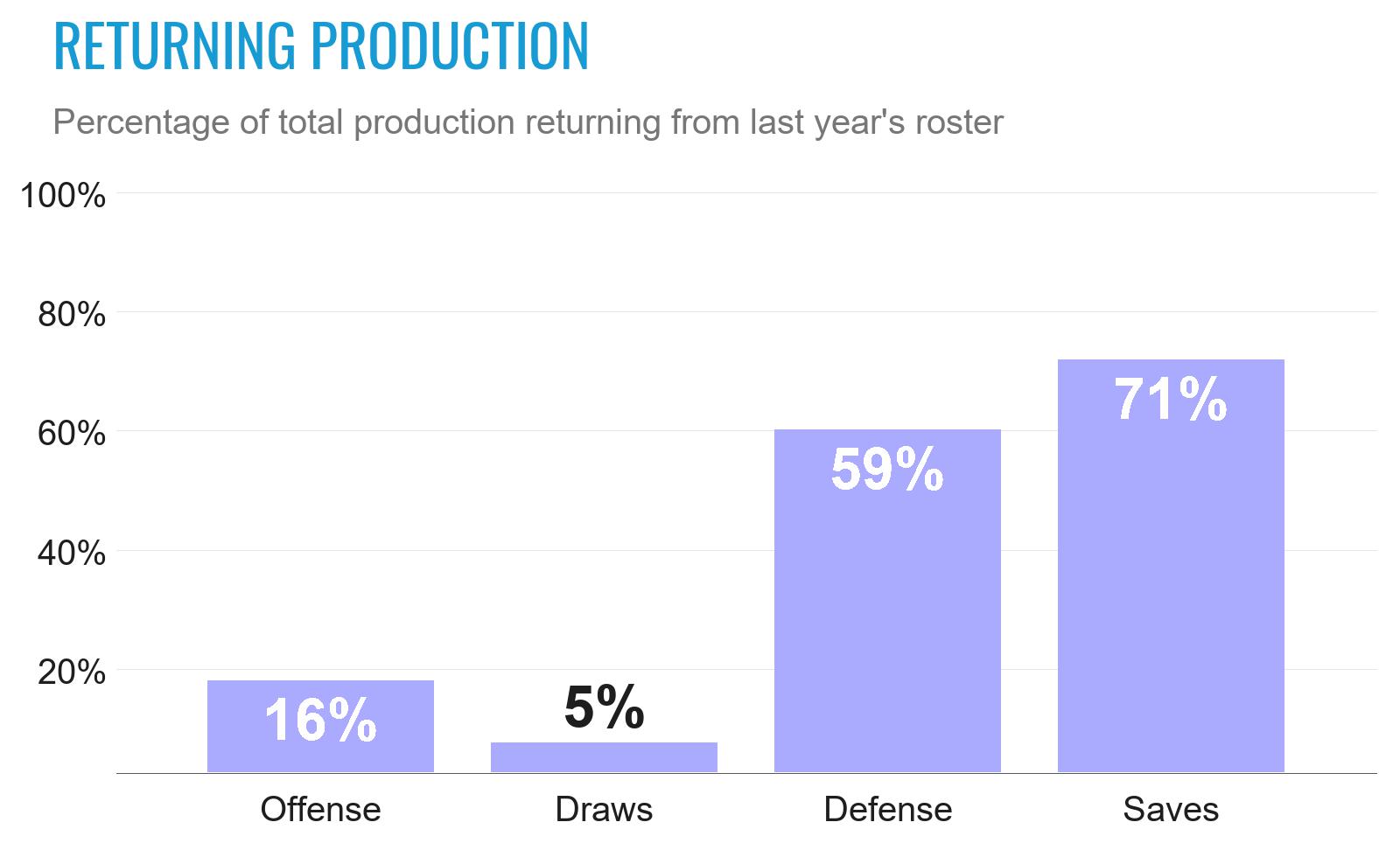
Offensively, the story is very similar: Yale is almost completely turning the page. The Bulldogs bring back only 16% of their offensive production from last year, meaning 84% of what they did on that end is gone. That’s a massive shift for an attack that finished in the 91st percentile nationally on an opponent-adjusted basis. The losses are not just about volume; they are about losing career-long outliers. Collignon leaves with career totals in the top percentile for points (236 career points) and goals (213 career goals), on top of her draw work. They also lose Fallon Vaughn, whose career numbers sit in the 99th percentile for assists (80 career assists), points (229 career points), and goals (149 career goals). That’s a rare combination of a high-level feeder and finisher gone in one shot. Lane and Carrasquillo were also key offensive pieces in addition to their draw work, and while they weren’t the only departures, that core group alone represents a huge share of what made last year’s offense so hard to guard.
Finding answers from within is possible, but the numbers underline just how big a leap is being asked of the returning attackers. Based on last year’s data, Ashley Kiernan is the most obvious candidate to see a major uptick in responsibility. She finished in the 43rd percentile for total production (EGA), but paired that with an individual efficiency rating of 86 on a 0–100 scale. She took 5.1% of Yale’s shots and accounted for 9.8% of their assists, so she was already functioning as a secondary creator with good decision-making. Scaling that up to primary-option usage is a different task, but the efficiency suggests she can handle more volume without the offense grinding to a halt. Beyond Kiernan, the picture gets murkier. Katie Clare, for example, was in the 1st percentile for total production (EGA) and had an individual efficiency rating of 1. That doesn’t mean she can’t develop into a contributor, but the statistical baseline says that if she is going to play a bigger role, it will require a significant jump from last year’s level. When 84% of your offense is gone, you’re not just looking for one breakout player; you need multiple attackers to jump several tiers at once.

The smaller roster size adds another layer to all of this. At 30 players, down from 38 last season, Yale is operating with fewer combinations and fewer built-in contingency plans. For a team replacing almost all of its offensive and draw-control production, that matters. There’s less room for extended experimentation, less ability to platoon specialized draw or offensive units, and more pressure on the top 18–20 players to stay healthy and perform. On the flip side, a tighter roster can sometimes speed up role clarity—players know where they stand, and the staff can lock into its core group earlier in the year. But in Yale’s case, with so many unknowns on attack and at the draw, the smaller roster probably means they’ll have to identify their new go-to options quickly and live with some growing pains rather than cycling through a long bench of alternatives.
In goal, the picture is much more stable, and that’s where this roster looks most “championship-caliber” on paper. Yale returns 71% of its saves from last season, and the most experienced keeper, Niamh Pfaff, already has a meaningful workload under her belt. Pfaff made 78 saves last year with a 41% save percentage, which is a solid base to build from, especially when compared to the departing Cami Donadio, who made 33 saves at a 35% clip. With no veteran transfer goalies coming in, it’s reasonable to expect Pfaff to get the first crack at the starting job, while freshman Olivia Smit adds depth and a developmental piece behind her. The twist is that, while the goalie room is in good shape, the unit in front of them is only partially intact. Yale returns 59% of its defensive contributions as measured by games played by defenders, so the keepers will be working behind a defense that is relatively inexperienced compared to last year’s group. Given that last season’s defense finished in the 90th percentile nationally on an opponent-adjusted basis, there’s still a strong foundation, but the returning goalie experience may have to cover for some early-season mistakes as newer defenders settle in.
Putting it all together, this roster feels like a classic high-floor, high-variance setup—but in a different way than usual. The floor is propped up by a proven defensive structure, an experienced goalie, and a program that has been operating at an elite national level. The variance comes almost entirely from the offense and the draw circle, where Yale is replacing not just production, but multiple players with career totals in the top or 99th percentiles nationally. If the new draw unit can keep them near even and a couple of attackers—starting with Kiernan—can make real jumps, the defense and goalie play are good enough to keep Yale in the championship conversation. If the draws slide and the offense can’t replace that 84% production gap, they’ll still be competitive, but probably more in the “tough out” category than a clear title favorite. The talent and track record of the program say contending is still on the table; the numbers say it’s going to require a lot of new faces to hit quickly.
Expected Goals Newsletter
This was originally published in our daily newsletter, Expected Goals, on Jan 15th. If you want to get more coverage and analysis like this, straight in your inbox every morning, sign up here. It’s free and over 1,300 other lacrosse folks have signed up.
More from the Expected Goals Newsletter
-
Schedule Preview: North Carolina: A brutal four-game, 12-day stretch could decide UNC’s RPI ceiling and postseason path
-
Schedule Preview: UMass: A softer slate means fewer chances to move the needle, even if the win total looks pretty good
-
Schedule Preview: Yale: A softer non-league slate boosts expected win totals but may make a top-tier tournament seed tougher to grab
P.S. What did I miss? Data-centric analyses like this can miss things that don’t show up in the stats (i.e. injuries/coaching changes). If you can help explain any of the above, put it in the comments.


