Roster Analysis: Wooster WLAX
Wooster’s 2026 roster sets up as a “tight” group: 20 players this year, down from 26 last season. That’s still a workable, fairly standard roster size, but it does change the margin for error. With fewer bodies, there’s less flexibility for wholesale line changes, fewer situational specialists, and more pressure on the top 12–14 players to carry heavy minutes. For a program that just put together a solid season on both sides of the ball, the question isn’t whether there’s enough talent to compete—it’s whether this smaller, more top-heavy group can sustain last year’s level while absorbing some major losses.
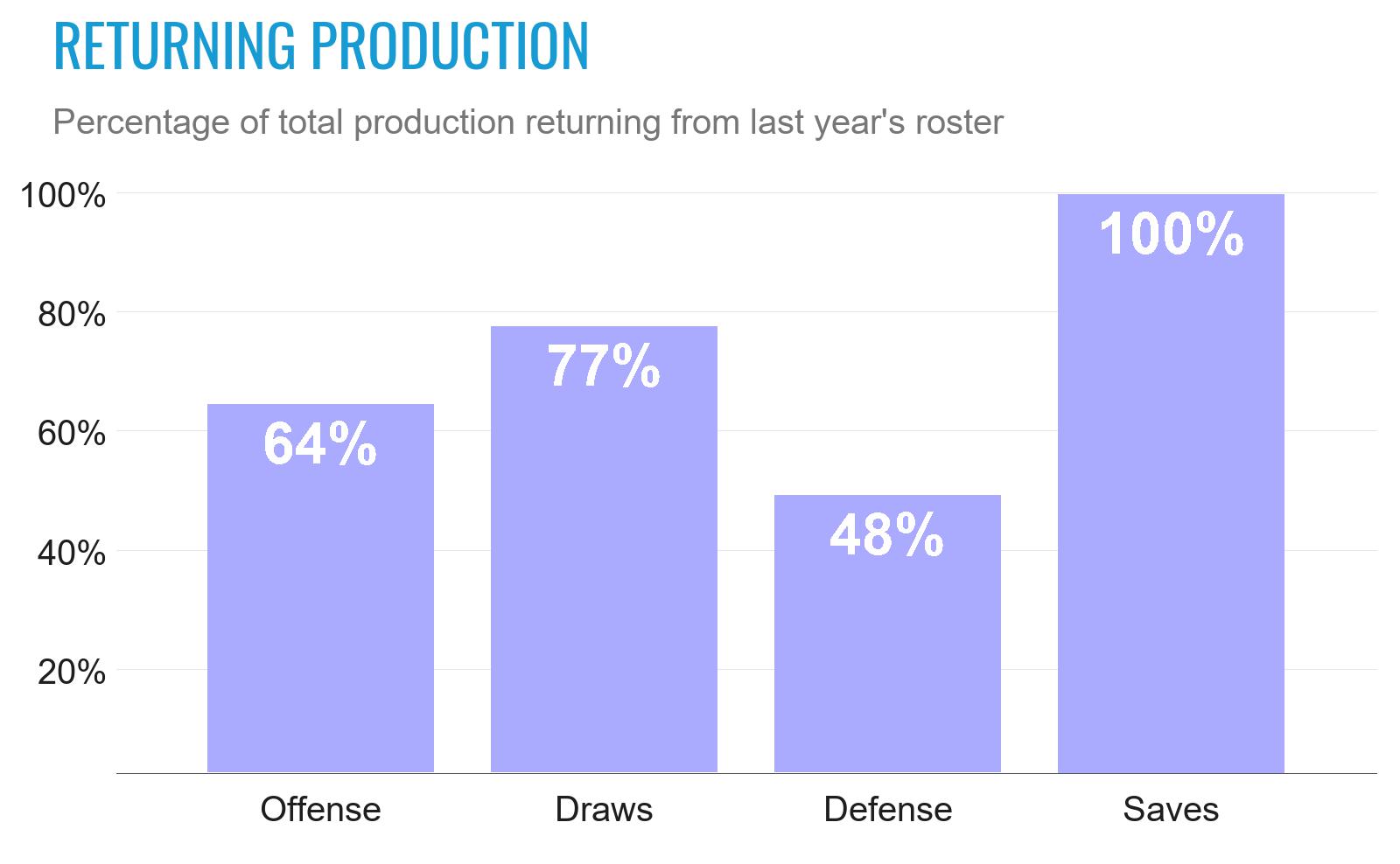
Defensively, the concern is pretty clear in the numbers. Wooster is only bringing back 48% of its defensive experience, measured by games played by defenders. That means 52% of last year’s defensive reps have walked out the door from a unit that finished in the 80th percentile nationally. That’s the profile of a defense that was solid—not elite, not a glaring weakness—but now has to rebuild on the fly. The loss of Bella McCloskey is a big part of that story. Over her career, she appeared in 34 games and last year was their most productive defender in terms of ground-ball work, accounting for 6.6% of Wooster’s total ground balls. That kind of presence—on the field a lot, consistently around the ball—doesn’t get replaced by one player.
On top of that, Wooster is losing an extremely impactful defender in Lexi Sarne, who finishes her career in the top percentile nationally for career caused turnovers with 80 total. That’s a true playmaker on the back end, not just a steady role player. When you strip out that kind of disruption and pair it with the broader 52% loss in defensive experience, you’re looking at a group that almost has to take some early lumps as new leaders emerge. Last year’s 80th-percentile defensive performance is a high bar to hit again with this much turnover; the more realistic question is whether they can stay in the “solid” range while the younger or less-tested defenders grow into bigger roles.
The good news is that Wooster is in a very stable spot in goal, and that can smooth over some of the defensive transition. They return 100% of their saves from last season, and all three goalies are back: Audrey Richardson, Taylor Noe, and Brooke Benjamin. Richardson is the clear incumbent, with 20 appearances last year, facing 300 shots and posting a 43% save percentage for a unit that finished in the 59th percentile in save rate. Noe (3 games, 14 shots faced, 4 saves) and Benjamin (4 games, 12 shots faced, 8 saves) both saw limited but real action. There are no freshmen keepers listed and no experienced transfers, so it’s reasonable to expect Richardson to get the first crack at the starting job again, with two backups who at least have seen live bullets. For a defense that’s replacing so much in front of the cage, having a fully returning goalie room is a real stabilizer.
On offense, the picture is similar: still a strong foundation, but with some serious holes to patch. Wooster returns 64% of its offensive production from last year, meaning 36% walks out the door from an offense that ranked in the 82nd percentile nationally on an opponent-adjusted basis. That’s a high-performing unit by any standard, and it wasn’t just one player carrying the load. The biggest name leaving is Kaitlyn McBride, who accounted for 15% of Wooster’s shots, 12% of their assists, and 15% of their offensive EGA last season. She was their highest-usage option, and with an individual efficiency rating in the 67th percentile, she was not just a volume shooter—she was reasonably efficient as well. Replacing that combination of usage and competence is not trivial. If the players who absorb her touches are more efficient, the offense could actually hold steady or even improve. If they’re less efficient, the unit likely slides back a bit from that 82nd-percentile mark.
There’s also the loss of Madelyn Noll, who accounted for 8% of last year’s offensive production. That’s another meaningful chunk of EGA gone, adding to the pressure on the returning core. And then there’s the long-term cornerstone: Wooster is losing an extremely impactful offensive player in Kenzie Morris, who finishes her career in the top percentile nationally for career points (229 total), goals (183 total), and draw control wins (232 total). That’s not just “a good player leaving”; that’s the kind of career stat line you build an era around. Even if some of that production had already been redistributed in recent seasons, the program-level impact of losing that kind of career output is real.
The counterweight to those losses is that Wooster’s top option from last season is back in the fold. Lizzie Hardy was the highest play-share player on the roster last year and will again be the focal point. She finished in the 93rd percentile for total offensive production (EGA) with an individual efficiency rating of 56 on a 0–100 scale. She took 12.0% of Wooster’s shots and recorded 7.0% of their assists, so she’s already proven she can handle a central role in a high-functioning offense. Behind her, Brynne Snaguski looks like a key secondary piece; she was in the 83rd percentile for total production (EGA) and posted an impressive individual efficiency rating of 92. Between Hardy’s heavy usage and Snaguski’s efficiency, there’s a credible path to Wooster staying in that “very strong” offensive tier, even if the ceiling might be a bit lower without McBride and the lingering shadow of Morris’s career numbers.
Draw controls tie a lot of this together, and Wooster is actually in a good spot there despite losing Morris. Last year’s draw unit finished in the 85th percentile for opponent-adjusted draw-control win rate, and the main engines of that success are back. Hardy returns after finishing with 113 draw controls, and she’s joined again by Sidney O’Rourke, who also recorded 113 draw controls. They do lose Morris’s 49 draw controls from last season, and there’s no experienced specialist coming in via the portal, but when you bring back two players who each handled over 100 draws, you’re starting from a position of strength. Given the smaller roster and the turnover elsewhere, continuing to win possessions at that kind of rate would go a long way toward keeping Wooster on its upward track.
Big picture, this roster should keep Wooster competitive on both ends, but it may be a bit more up-and-down than last year. A smaller roster, heavy defensive turnover, and the loss of a few key offensive pieces all raise the risk of a step back. On the plus side, the entire goalie group returns, Hardy and Snaguski give them a proven top-end duo, and the draw unit brings back two 100-plus control players. That looks like enough to keep them in the solid-program tier. If the new defenders and secondary scorers click early, they could even push higher.
Expected Goals Newsletter
This was originally published in our daily newsletter, Expected Goals, on Jan 5th. If you want to get more coverage and analysis like this, straight in your inbox every morning, sign up here. It’s free and over 1,300 other lacrosse folks have signed up.
More from the Expected Goals Newsletter
-
Roster Analysis: Scranton: Scranton returns key anchors, but replacing so much experience turns 2026 into a tightrope walk, not a victory lap
-
Schedule Preview: Wesleyan (CT): By upgrading their non-conference slate, Wesleyan trades comfort for a shot at a championship-level résumé
-
Schedule Preview: Gettysburg: Sims point to a strong season that keeps Gettysburg firmly in the at‑large and protected‑seed hunt
-
Roster Analysis: Denison: Denison’s next test: can a veteran-heavy roster replace Devuono without losing its offensive edge?
-
Roster Analysis: Wesleyan (CT): Green’s return as the go‑to playmaker gives Wesleyan a clear path to stay in the national mix
-
Roster Analysis: William Smith: William Smith’s ceiling rises on offense and draws, but a rebuilt defense could pull the whole thing down
P.S. What did I miss? Data-centric analyses like this can miss things that don’t show up in the stats (i.e. injuries/coaching changes). If you can help explain any of the above, put it in the comments.


