Roster Analysis: Florida WLAX
Florida’s 2026 roster looks like a classic “high floor, uncertain ceiling” group. On paper, this is still one of the more talented lineups in the country, but it’s also a group that has to answer real questions in goal and in how it replaces a once‑in‑a‑generation offensive career. The Gators are coming off a year where a 96th‑percentile offense and a 91st‑percentile defense didn’t quite translate into the postseason finish fans are used to. The big picture for 2026 is whether the experience they’ve banked and the transfer additions are enough to tighten up the weak spots and push them back into the true national‑title tier.
From an experience standpoint, this is one of the most seasoned rosters anywhere. Using the top 10 players as a proxy for the main rotation, the median Gator has already appeared in 41 career games. That’s not just “we’ve played a bit” experience; that’s essentially three full seasons of run for the typical rotation piece. Nine players have logged at least 30 career games, which means most of the key contributors have been through multiple conference races and NCAA runs. Interestingly, the roster lists 0 seniors and 0 grad students, so this isn’t an old group in terms of class, but it is very old in terms of mileage. That combination—veteran game counts without a top‑heavy class structure—usually points to a stable core that should avoid wild swings week to week.
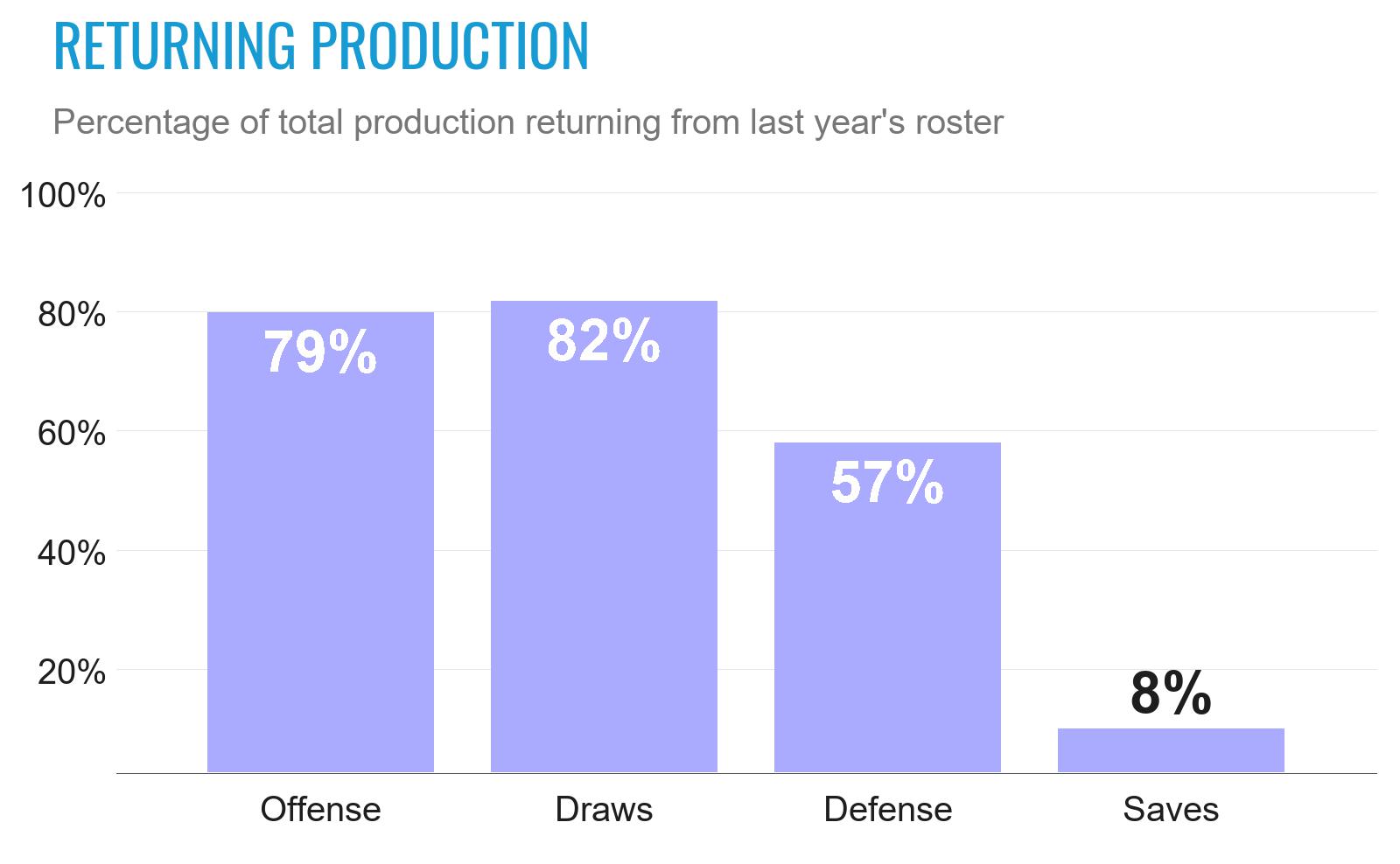
The one place where the cupboard looks thin is in goal, and that’s where the experience story flips. Florida returns just 8% of their saves from last season, with Elyse Finnelle’s departure looming large. Finnelle made 107 saves with a 46% save rate, anchoring a defense that finished in the 91st percentile nationally on an opponent‑adjusted basis. That kind of production is hard to replace, and there is no obvious, proven “plug‑and‑play” answer on this roster. The staff did go to the portal for help, bringing in Paige Crowther from Oregon. Crowther made 89 saves last year, but her 36.9% save percentage is a concern if you’re hoping for immediate, high‑end stability in net. The returning option is Susan Radebaugh, who saw lighter duty: 10 games, 30 shots faced, and a 47% save percentage. That efficiency is encouraging, but the workload is small enough that it’s hard to know how it scales over a full season. Freshman keeper Maya Soskin adds another option, but again, you’re talking about unproven production at the college level. Complicating all of this is the fact that Florida returns only 57% of their defensive contributions, measured by the number of games each defender appeared in. So whoever wins the job in goal will be playing behind a defense that is less experienced, at least in terms of game appearances, than the offense or the overall roster. For a unit that was in the 91st percentile last year, that combination—new goalie plus less‑tested defense—makes it fair to wonder if they can stay at that level.
Offensively, the story is more reassuring, even if it comes with one massive asterisk. Florida brings back 79% of last year’s offensive production, so more than three‑quarters of the scoring and creation that powered a 96th‑percentile, opponent‑adjusted offense is still in Gainesville. That’s a strong base to build from. The problem is that the 21% they lost is almost entirely wrapped up in one of the most productive careers the sport has seen. Jordan Basso exits with career totals that project into the top percentile nationally for assists (165 total), points (418 total), and goals (253 total). Last season alone, she accounted for 21% of Florida’s assists and 12% of their total offensive EGA, all while posting an individual efficiency in the 88th percentile. That’s not the kind of hole you “replace” in a single offseason; it’s more about redistributing responsibility and hoping the collective can stay close to the same level.
The good news is that Florida’s returning core is strong enough that this doesn’t look like a full rebuild on attack. Gianna Monaco took 21% of the team’s shots and backed that usage up with individual efficiency in the 85th percentile and per‑game impact in the 93rd percentile. She’s a proven high‑volume finisher who can shoulder more of the scoring load. Frannie Hahn returns as the primary table‑setter; she recorded 33% of Florida’s assists last year, with individual efficiency in the 80th percentile and per‑game impact in the 85th percentile. If anyone is going to absorb a chunk of Basso’s initiation duties, Hahn is the most obvious candidate. Then there’s Clark Hamilton, who took 14% of the team’s shots and was one of the most efficient players on the roster—90th percentile in individual efficiency and 88th percentile in per‑game impact. With those three back, the spine of a top‑tier offense is intact, and the question becomes less “can they score?” and more “can they stay in that 96th‑percentile neighborhood without a superstar gravity piece?”
The draw unit is another area where returning production and transfer help intersect in a promising way. Florida brings back 82% of last year’s draw‑control production, including Gabby Greene, who posted an 84th‑percentile draw‑related fEGA with 32 draw controls. That group collectively produced a 69th‑percentile, opponent‑adjusted draw win rate—solid, but not dominant. To push that closer to elite, they’ve added Notre Dame transfer Ava Kristynik, who was in the 91st percentile for draw‑related fEGA last season with 50 draw controls. That’s a real track record of impact, not just depth. If Kristynik integrates well and either takes a primary role or forms a strong tandem with Greene, Florida has a realistic path to turning a “good” draw unit into one that consistently tilts possession in their favor.
Taken together, this roster looks like one that should be better than last year in some of the finer‑margin areas, even if it might take a small step back in raw defensive efficiency. The experience level—41 career games for the median rotation player and nine players with at least 30 career games—suggests a group that should handle tight games and tough stretches with more composure. The offense returns a solid majority of its production, led by Monaco, Hahn, and Hamilton, and it’s being supplemented by transfer help on the draw that could quietly be one of the biggest upgrades on the roster. The flip side is that the goalie situation is unsettled, and the defense in front of that position is only returning 57% of its game‑appearance “experience.” For a program with Florida’s standards, that probably means the path back to where fans expect them to be runs through two things: finding a steady hand in net and keeping the offense operating in that top‑5‑ish, 96th‑percentile range. If they can do both, this roster has enough proven production and experience to put last season’s underwhelming finish in the rearview. If the goalie spot doesn’t stabilize, they may again be very good, but just a notch short of the true elite.
Expected Goals Newsletter
This was originally published in our daily newsletter, Expected Goals, on Dec 30th. If you want to get more coverage and analysis like this, straight in your inbox every morning, sign up here. It’s free and over 1,300 other lacrosse folks have signed up.
More from the Expected Goals Newsletter
-
Roster Analysis: Princeton: Losing a centerpiece on the draw leaves Princeton walking a thinner line in the possession game
-
Roster Analysis: South Florida: With firepower up front but a reset in goal and defense, South Florida faces a true hinge year
-
Roster Analysis: Army: With Duffy and Reilly driving the attack, Army bets on continuity in 2026
-
Roster Analysis: North Carolina: The Heels bring back an elite defense, but nearly two-fifths of last year’s offense is gone
-
Roster Analysis: Penn: Can Catherine Berkery turn solid production into star-level efficiency and help Penn reload its attack without Brandt?
P.S. What did I miss? Data-centric analyses like this can miss things that don’t show up in the stats (i.e. injuries/coaching changes). If you can help explain any of the above, put it in the comments.


