Roster Analysis: Salisbury WLAX
Salisbury heads into 2026 with a roster that looks capable of a bounce-back, but not without a few real questions to answer. The headline is that most of the core from a very strong underlying team is back: an offense that finished in the 96th percentile nationally on an opponent-adjusted basis, a draw unit in the 97th percentile, and a defense in the 94th percentile. The flip side is that last year’s on-field results didn’t quite match those elite efficiency numbers, and some of the players who did the heavy lifting—especially on defense—are gone. How quickly the new pieces settle in will go a long way toward deciding whether this season looks more like “business as usual for an elite program” or another year of “pretty good, but not quite peak Salisbury.”
From a roster-construction standpoint, 41 players (up from 40 last season) puts Salisbury on the larger end nationally. That kind of size matters for a program that wants to play fast, pressure the ball, and keep tempo high for four quarters. Depth “should not be an issue at all” isn’t just a throwaway line here: with this many options, the staff can run multiple midfield lines, keep the draw unit fresh, and mix-and-match on defense without overextending anyone. It also means there’s real competition at almost every spot. The risk with a big roster is that you’re relying on a lot of players who haven’t proven it yet, but at a place like Salisbury, the track record suggests that at least a few of those depth pieces usually turn into real contributors.
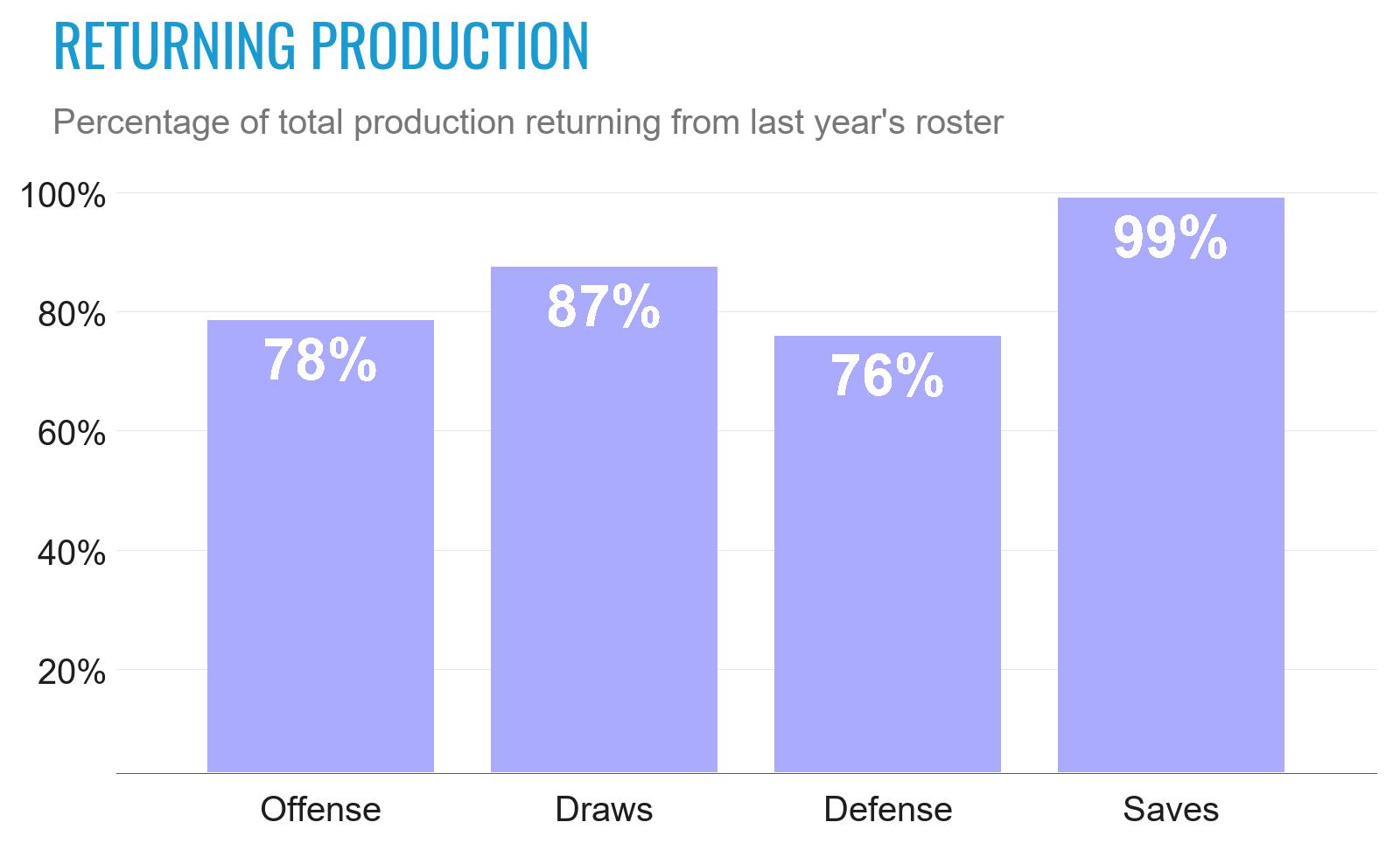
Offensively, the numbers say the foundation is in good shape. Salisbury returns 78% of its offensive production by EGA, which is a solid majority for a team that was already in the 96th percentile in opponent-adjusted offense. The biggest hole is clearly the loss of Alexandra Parker, who accounted for 20% of the team’s assists and 9% of total offensive EGA last year. She was one of the main initiators, and her individual efficiency sat in the 72nd percentile—comfortably above average. That combination of volume and efficiency is not trivial to replace. If the players who absorb her touches can push that efficiency higher, the offense might actually tick up despite losing her; if those touches go to less efficient options, you could see some slippage, even with most of the production back.
The good news is that Salisbury still has a very strong core of proven weapons. Audrey Harrington returns as the primary table-setter, having recorded 32% of the team’s assists last season. She paired that usage with an individual efficiency in the 80th percentile and per-game production in the 78th percentile, which is exactly the kind of profile you want from your lead initiator. With Parker gone, Harrington’s role as the organizer becomes even more central, but she’s already shown she can handle a big share of the offense without her efficiency falling off. Around her, there’s plenty of finishing punch. Julianna Ott took 17% of Salisbury’s shots and posted per-game production in the 85th percentile, with individual efficiency in the 70th percentile—above-average efficiency at real volume. That’s a reliable top-option profile. Right behind her, Miranda Mears took 15% of the shots and was even stronger on a per-touch basis, with individual efficiency in the 80th percentile and per-game production in the 61st percentile. Put together, Harrington’s high-end creation plus the Ott/Mears finishing combo gives Salisbury a clear offensive identity; the main question isn’t “is there enough talent?” but “who becomes the second initiator to replace Parker’s 20% assist share?”
On draws, the picture is even more straightforward: this should again be one of the strengths of the team. Salisbury returns 87% of its draw-control experience, and more importantly, the primary draw-takers are back. Last year, Ott was in the 94th percentile nationally for total draw-control-related production (fEGA), winning 76 draws. That’s not just a role-player number; that’s a true engine for possession. With the draw unit already ranking in the 97th percentile in opponent-adjusted win rate, keeping the main specialist and most of the experience intact suggests this phase of the game is set up to remain elite. The turnover is mostly in the supporting cast—wing players and depth options—which matters, but it’s a lot easier to plug in athletic, new wings around an established draw-taker than it is to replace the person actually taking the draws.
Defensively, things are a bit more complicated. Salisbury returns 76% of its defensive experience by games played, which is a solid majority, but the 24% they do lose includes some very impactful pieces. Most notably, Natalie Held finishes her career in the top percentile nationally for career caused turnovers, with 101 total. That’s the kind of player who changes how opponents game-plan; you don’t just “replace” that overnight. Even with three-quarters of the defensive experience back, losing a defender with that level of ball-hawking production means someone has to step into tougher matchups and take on more responsibility in the ride and in settled sets. For a unit that ranked in the 94th percentile last season, any early missteps in those new roles could show up quickly on the scoreboard.
In net, Salisbury at least has continuity, and that’s not nothing. Paige Ellis returns after appearing in 20 games, facing 281 shots, and posting a 46% save percentage. Those are real starter-level reps, not spot duty. Behind her, Jaclyn Bange is back as well, with 5 games played and 16 shots faced (8 saves). As a team, Salisbury finished in the 96th percentile for save percentage last year, so the goaltending environment was excellent. The question is whether Ellis and Bange can maintain something close to that standard without some of the same defensive pieces in front of them—especially without Held creating extra possessions and bailing the unit out with caused turnovers. Still, having an experienced goalie who has already seen nearly 300 career shots is a stabilizing factor as the defense reshuffles.
Put it all together, and this roster looks like one that *should* give Salisbury a real shot at a bounce-back season. The offense brings back most of its firepower from a 96th-percentile unit, with Harrington, Ott, and Mears providing a proven spine. The draw unit, led by Ott’s 94th-percentile fEGA and 76 draw wins, has the pieces to stay in the 97th-percentile neighborhood and keep the possession edge that elite teams live on. The concern is whether the defense can absorb the loss of a top-percentile career disrupter like Held while still playing at a 94th-percentile level, even with 76% of the experience and an established goalie like Ellis returning. Because this is Salisbury, the baseline expectation is still high; the roster suggests there’s enough here to push back toward the top tier. Whether they actually get there will likely come down to two things: how efficiently they replace Parker’s initiating on offense, and how quickly the new defensive leaders emerge in a post-Held world.
Expected Goals Newsletter
This was originally published in our daily newsletter, Expected Goals, on Dec 29th. If you want to get more coverage and analysis like this, straight in your inbox every morning, sign up here. It’s free and over 1,300 other lacrosse folks have signed up.
More from the Expected Goals Newsletter
-
Roster Analysis: Denison: Denison’s next test: can a veteran-heavy roster replace Devuono without losing its offensive edge?
-
Roster Analysis: Wesleyan (CT): Green’s return as the go‑to playmaker gives Wesleyan a clear path to stay in the national mix
-
Roster Analysis: William Smith: William Smith’s ceiling rises on offense and draws, but a rebuilt defense could pull the whole thing down
-
Roster Analysis: Elmhurst: A rebuilt roster, a green core, and massive losses on defense and draws put Elmhurst’s progress to the test
P.S. What did I miss? Data-centric analyses like this can miss things that don’t show up in the stats (i.e. injuries/coaching changes). If you can help explain any of the above, put it in the comments.


