Roster Analysis: UMBC WLAX
UMBC’s 2026 roster has the feel of a reset year more than a “run-it-back” year. Last season was pretty middle-of-the-road across the board, and this group looks like it has more volatility baked in: there’s some real upside in Catonsville if the new pieces hit, but also plenty of ways things could slide backward, especially on the defensive end and at the draw.
The biggest immediate storyline is in goal. UMBC returns zero saves from last season after losing starter Isabella Fontana, who made 98 saves with a 40% save percentage. That’s a major hole on a defense that already wasn’t elite, finishing in the 64th percentile nationally in opponent-adjusted defensive efficiency. To fill that gap, UMBC is leaning hard on the transfer portal and freshmen. Transfer goalie Emine Luznar comes in from Campbell with 21 career saves and a 30.9% save percentage. That’s not a big career sample, and the efficiency is well below what UMBC got a year ago when the team finished in the 35th percentile in save percentage. Freshman keeper Madyson Hamilton and fellow goalie Ava Reed round out the room, but both are total unknowns at the college level. With no returning goalkeeping experience and no proven high-efficiency option in the group, this is one of the biggest swing factors on the roster. If one of the new goalies settles in quickly, the defense might hold steady; if not, a unit that was already just “fine” could slip into clear liability territory.
That uncertainty in the cage is compounded by how inexperienced this roster is overall. Using the top-10 players in projected rotation as a proxy, the median UMBC rotation player has appeared in only 17 career games. Only 1 player on the roster has logged at least 30 career games, and there are just 5 seniors or grad students compared to 9 players who have never appeared in a collegiate game. That’s not just “young” in a generic sense; it means that when games get tight, UMBC will be leaning heavily on players who haven’t lived through a lot of late-game situations at this level. The flip side is that this kind of roster can surprise people if a couple of those less-experienced players turn into real difference makers, but from a pure stability standpoint, it’s a much wider range of outcomes than you’d see from a veteran group.
On defense, the numbers underline how much turnover UMBC is dealing with. By games played, the Retrievers return only 41% of their defensive experience, meaning 59% of last year’s defensive appearances and reps have walked out the door. Given that last year’s defense was a 64th-percentile unit—solidly average, not dominant—that’s a lot of know-how to replace. And they’re trying to do it with a green roster behind a goalie group that has no returning saves and no proven high-efficiency anchor. When you put that together, it’s hard to project this defense as better than last year on paper. The realistic best-case scenario is probably a short-term step back early in the season with some improvement as the new defenders and goalies settle into their roles.
The draw-control unit is facing a similar rebuild. UMBC returns only 36% of its draw-control experience from last season, and that’s a big deal for a team that finished in the 65th percentile nationally in opponent-adjusted draw-control win rate—a solid, but not elite, unit that helped keep possession numbers respectable. The biggest loss is clear: Lauryn Warfield, who was in the 96th percentile nationally in total draw-control-related production (fEGA), with 74 draw-control wins and 15.6 total draw-control EGA. That’s true “engine of the draw unit” production. The most obvious internal candidate to pick up that slack is returner Ella Killian, who was herself in the 95th percentile for draw-control-related fEGA and recorded 71 draw controls last year. She’s already shown she can handle a heavy load on the circle. The question is whether UMBC can find enough complementary options around her to keep the overall unit near that 65th-percentile level. With nearly two-thirds of last year’s draw experience gone, that’s far from guaranteed.
Offensively, UMBC is in a slightly better spot, but still not without questions. The Retrievers return 52% of their offensive production from a group that finished in the 67th percentile in opponent-adjusted offensive efficiency. That’s a decent baseline—above average, but not elite—and they do have some proven pieces back. The biggest loss is finisher Katana Nelson, who took 24% of UMBC’s shots and accounted for 24% of their total offensive EGA. Her individual efficiency was in the 67th percentile, so she wasn’t just a volume shooter; she was an above-average finisher who consistently put herself in good spots. Replacing that combination of usage and efficiency is never simple. If her shots and touches get redistributed to a more efficient player, the offense could actually improve; if they go to lower-efficiency options, the unit could slide backward from that 67th-percentile mark.
The good news is that UMBC does have a couple of clear offensive anchors to build around. Libby Staples should remain a focal point after finishing last year with the 4th-highest play share on the team. She did a little bit of everything: 10% of the team’s total ground balls and 18% of their total assists, with an individual efficiency in the 84th percentile and per-game production in the 82nd percentile. That’s high-level two-way impact backed up by the numbers. Alongside her, Emily Knapp was the top option in terms of usage, taking 19% of UMBC’s shots and recording 19% of their assists. Her per-game production landed in the 91st percentile nationally, and while her individual efficiency was more modest—66th percentile—she was still clearly an above-average offensive driver. Between Staples and Knapp, UMBC has two proven high-usage, above-average-efficiency creators to structure the offense around, even with Nelson gone.
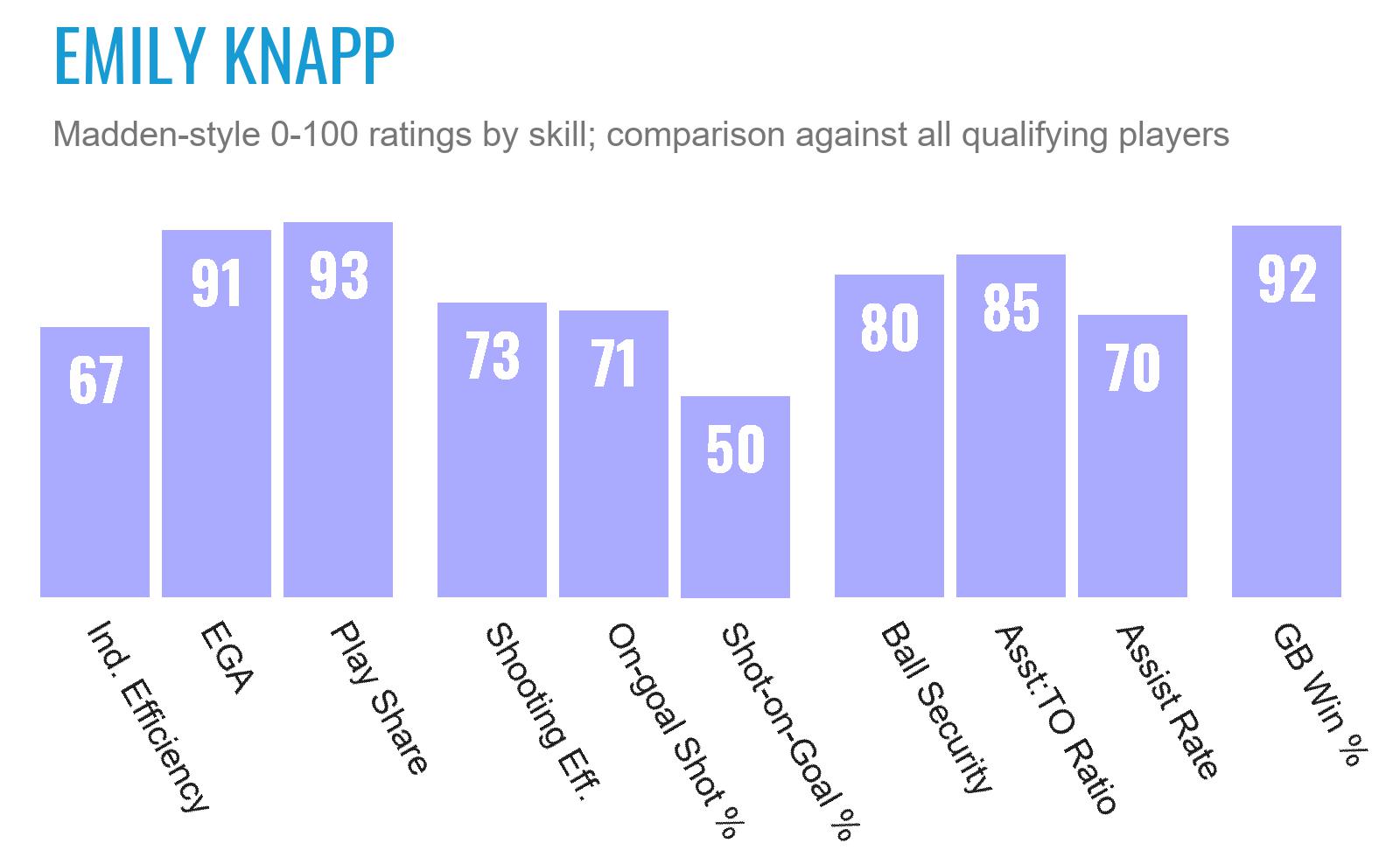
Putting it all together, this roster doesn’t scream “big step forward” or “total collapse,” but it does lean a bit more toward risk than comfort. The offense has enough returning production and quality—67th-percentile efficiency last year, 52% of that output back, plus two strong anchors in Staples and Knapp—that it could roughly hold its ground if someone adequately absorbs Nelson’s finishing role. The bigger worries are on the other side of the ball: a defense that returns only 41% of its experience, no returning saves, a transfer goalie with a 30.9% career save percentage, and a draw unit that has to replace 64% of its experience and a 96th-percentile producer in Warfield. For a program that’s been pretty average in the national picture and is coming off a fairly non-descript year, this roster profile points slightly more toward a step back than a clear step forward—unless the young and new pieces, especially in goal and on the draw, grow up fast and hit the high end of their potential.
Expected Goals Newsletter
This was originally published in our daily newsletter, Expected Goals, on Dec 24th. If you want to get more coverage and analysis like this, straight in your inbox every morning, sign up here. It’s free and over 1,300 other lacrosse folks have signed up.
More from the Expected Goals Newsletter
-
Roster Analysis: Penn: Can Catherine Berkery turn solid production into star-level efficiency and help Penn reload its attack without Brandt?
-
Roster Analysis: Michigan: How spreading Smith’s shots around could keep Michigan’s offense in that “very good” gear
-
Roster Analysis: Stony Brook: With 74% of its offense gone, Stony Brook is betting a new cast can keep it in the national chase
P.S. What did I miss? Data-centric analyses like this can miss things that don’t show up in the stats (i.e. injuries/coaching changes). If you can help explain any of the above, put it in the comments.


