Rising Star: Jake Feeney (Holy Family MLAX)
Jake Feeney’s 2025 season for Holy Family was the kind of year that quietly tells you a lot about a player’s wiring. With a 12.2% usage rate and the second-highest play share on the Tigers’ offense, he wasn’t a bit player; he was in the middle of what they were trying to do. He carried a 77th percentile individual efficiency, drove 29.8% of the team’s assists, and still managed to have 49% of his own goals come off feeds, which says he could both create and finish within the flow. Nothing here screams “finished product,” but it does scream “trustworthy guy with the ball who already helps you win.”
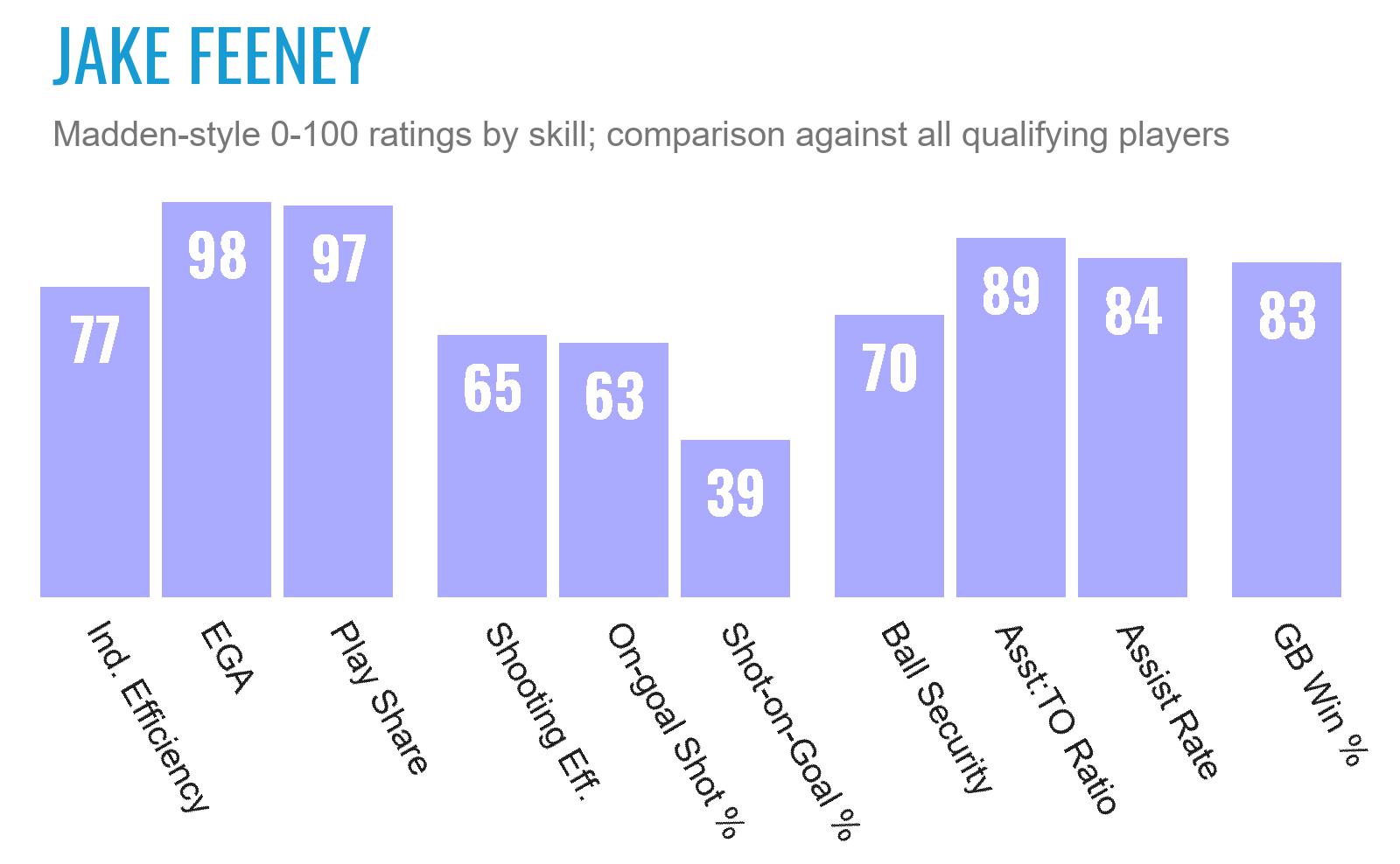
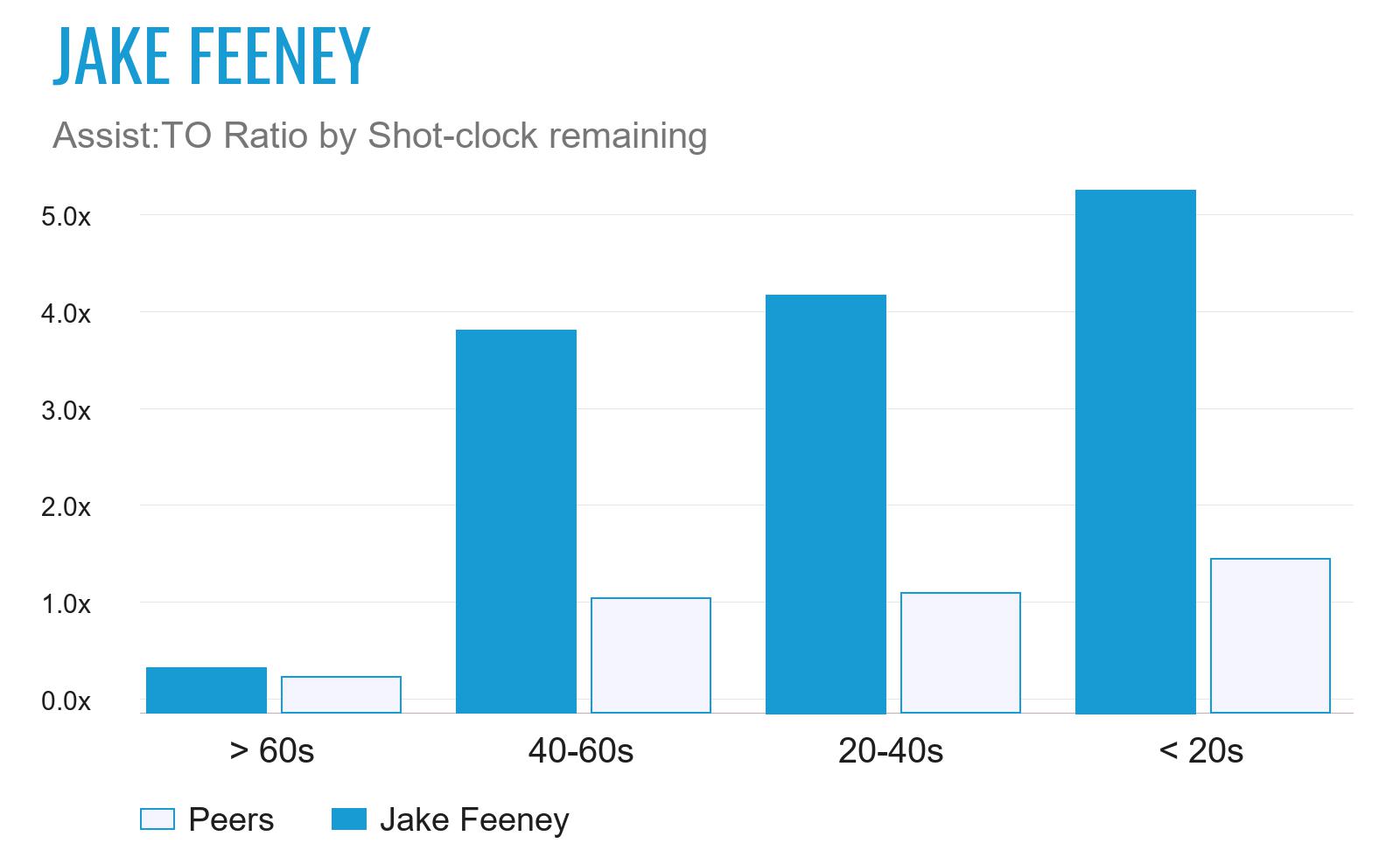
If you’re circling one skill as a real plus, it’s his passing and overall creation for others. Feeney posted an 84th percentile assist rate, which lined up with what the usage numbers hinted at: he was one of the central decision-makers, not just a complementary feeder. What stands out is that he did it without turning into a turnover machine. His ball security sat at a solid 70th percentile, so the Tigers were getting high-end table-setting without paying a heavy tax in empty trips. The shot-clock splits back this up: with 20–40 seconds left, his assist-to-turnover ratio was 4.00 vs. a peer group at 1.16, and in the final 20 seconds it was 5.00 vs. 1.48. That’s a guy who can keep reading the defense deep into a possession, when many players either force a shot or cough it up. High-usage, high-assist, and low-mistake is a tough combo to find, and he checked all three boxes this year.†
Looking at the comp group of 34 similar players, you get a mixed bag of futures, which is useful in its own way. On the optimistic end, the best-case path looks a lot like Travis Reid at Assumption. In 2017, Reid’s profile wasn’t wildly different: 89th percentile shooting efficiency, 76th percentile assist rate, 69th percentile ball security, and a 65th percentile overall efficiency. Over his remaining season, he jumped to the 98th percentile in shooting efficiency, 87th percentile assist rate, and 70th percentile ball security, with a 91st percentile overall efficiency. For Feeney to trace that kind of arc, the biggest leap would have to come in shooting efficiency, where he’s already at a respectable 65th percentile but not yet in that “you can’t leave him” tier. The comps who improved as a group saw only a tiny bump in shooting efficiency on average (77th → 78th percentile), but they made real strides in ball security (38th → 51st) and assist rate (62nd → 73rd). In other words, the ones who popped didn’t suddenly become snipers; they tightened up their decision-making and leaned harder into being reliable playmakers.
The darker side of the comparison set is just as telling. Twenty of the 34 similar players actually saw their effectiveness slide over the rest of their careers. For that declining group, shooting efficiency dropped from the 85th to the 77th percentile, but the bigger story was ball security falling from the 49th to the 37th percentile. That’s the pattern you don’t want to see: as roles grow or defenses key in, turnovers creep up, and the overall efficiency follows them down. When you stack the two groups side by side, ball security is the clear fork in the road. The improvers climbed from 38th to 51st percentile in taking care of the ball; the decliners fell from 49th to 37th. Shooting efficiency moved some, but not nearly as sharply. That’s why, for this profile, the “swing stat” isn’t really shooting; it’s whether the player keeps or loses ground in how cleanly they manage possessions.
This is where the shot-clock deep dive helps shade in the picture for Feeney instead of just tossing him into one bucket or the other. That late-clock assist-to-turnover ratio—5.00 vs. a peer average of 1.48 in the final 20 seconds—lines up almost perfectly with what separated the successful comps: they became the guys who could squeeze value out of a possession without bleeding turnovers when things got tight. It suggests that what he’s doing isn’t just racking up easy assists in broken situations; he’s staying patient and accurate as the clock winds down, exactly when a lot of players in this usage band start forcing plays. If you’re trying to guess which side of the comp split he’s more likely to land on, that late-clock steadiness is one of the better pieces of evidence in his favor—without pretending it guarantees anything.
All of this feeds into what it could mean for Holy Family going forward. As a team, the Tigers’ turnover rate sat in the 27th percentile nationally (62nd in the rankings), which is a polite way of saying they gave the ball away more than most. Feeney, on the other hand, was already at that 70th percentile mark for ball security while carrying the second-largest offensive role. That creates a pretty straightforward path to team improvement: if his role grows and he simply holds his current level—no big leap, just “don’t backslide”—you’re effectively shifting more touches from lower-security players to a higher-security one. Given how the comps played out, the realistic hope isn’t that he suddenly becomes an elite shooter; it’s that he keeps being the guy who can run a big share of the offense, post top-end assist rates, and keep the turnover problem from getting worse on his stick. If that happens, there’s at least a chance that what was a 27th-percentile team weakness starts bending toward the middle of the pack—or better—just by leaning a little harder on the one player whose numbers say he can handle it.
Expected Goals Newsletter
This was originally published in our daily newsletter, Expected Goals, on Dec 4th. If you want to get more coverage and analysis like this, straight in your inbox every morning, sign up here. It’s free and over 1,300 other lacrosse folks have signed up.
More from the Expected Goals Newsletter
-
Roster Analysis: Westminster (UT): Can a seasoned trio turn Westminster’s solid attack into something closer to a real strength in 2026?
-
Roster Analysis: Davis & Elkins: Davis & Elkins brings back experience, but the real test is whether that continuity can finally slow the bleeding
-
Roster Analysis: Lake Erie: Lake Erie brings back touches on offense, but questions in goal, defense, and faceoffs could drag the whole thing down
P.S. What did I miss? Data-centric analyses like this can miss things that don’t show up in the stats (i.e. injuries/coaching changes). If you can help explain any of the above, put it in the comments.


