Rising Star: Brody Herr (Lawrence MLAX)
Brody Herr stepped into a real role for Lawrence this season and held his own. With a pretty high 9.1% usage and the 2nd-highest play share on the Vikings’ offense, he carried a meaningful slice of the load. He took a whopping 18.0% of the team’s shots, split his goals evenly between assisted and unassisted finishes (50% assisted), and still posted an impressive 65th-percentile individual efficiency. The two soft spots: a 35th-percentile ball security mark and a 41st-percentile assist rate.
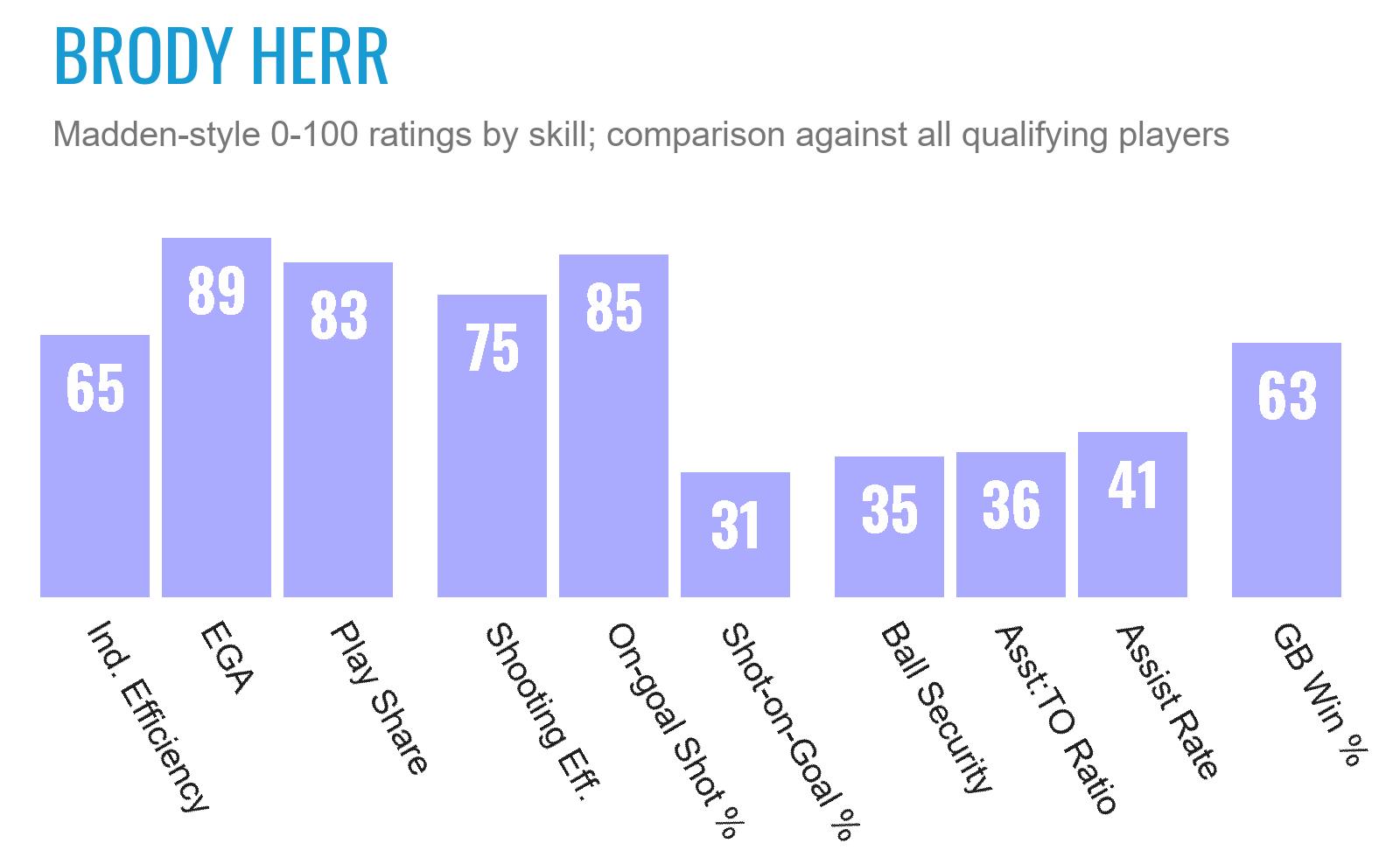
The big plus was shooting efficiency. Herr finished in the 75th percentile there, and with his shot share, that matters a ton. Shooting efficiency isn’t just about makes; it’s about avoiding possession-killers. Saved shots flip the field, while off-cage misses are often backed up. Herr’s profile suggests he kept a good chunk of his shots from turning into immediate losses, which, in plain terms, let the Vikings squeeze extra life out of possessions even when the net didn’t ripple. That’s a winning trait to carry forward.
On the projection front, there are nine good historical comps for this kind of “young, real-usage, shot-heavy, efficiency-forward” profile. The best-case path looks like Klein Woods, who did this at LaGrange. In 2023, Woods paired elite shooting efficiency (87th percentile) with steady ball security (77th) and a low assist rate (26th), netting a 60th-percentile overall efficiency. Over the rest of his career, he maintained strong-but-not-elite shooting (65th), kept that rock-solid ball security (77th), nudged the passing game up (assist rate to 32nd), and climbed to a 68th-percentile overall efficiency. For Herr to match that arc, the most obvious gap is ball security; Woods’ handle never dipped and that stability supported everything else.
Zooming out to the full comp set, only 2 of the 9 improved later. Those two, on average, juiced their shooting efficiency (69th to 79th), ticked up ball security (65th to 69th), and made the biggest leap in assist rate (23rd to 41st). The 7 who tailed off saw shooting efficiency slide hard (78th to 59th) and ball security sag a bit (72nd to 67th). The divider was playmaking growth: the improvers expanded how they set up teammates, while the decliners didn’t create enough new value elsewhere to offset the inevitable bumps that come when young players start to attract more defensive attention. For Herr, that paints a clear path forward. Keep the shot discipline that drives a 75th-percentile shooting-efficiency mark from drifting, and nudge the assist rate north; that’s the stat most tied to beating the odds with this profile. And while the Woods template points to cleaner handles helping the cause, the broader lesson is simpler: maintaining current ball security is good enough if the passing game grows. Most players with this blueprint don’t end up more efficient later, so the path is narrow—but it’s there.
Expected Goals Newsletter
This was originally published in our daily newsletter, Expected Goals, on Nov 17th. If you want to get more coverage and analysis like this, straight in your inbox every morning, sign up here. It’s free and over 1,300 other lacrosse folks have signed up.
More from the Expected Goals Newsletter
-
Rising Star: Griffin Doan: Unlocking Doan’s potential: sharper shooting could elevate his already strong passing game
-
Roster Analysis: Elmhurst: With Eli Spence back, Elmhurst hopes to maintain its offensive edge in 2026
-
Rising Star: Sam Sisk: How one low-usage shooter turned routine touches into high-value chances for Babson’s offense
P.S. What did I miss? Data-centric analyses like this can miss things that don’t show up in the stats (i.e. injuries/coaching changes). If you can help explain any of the above, put it in the comments.


