Competitive Juice: Why we are on the cusp of a revolution in practice planning
So far, the pinnacle of my coaching career has been as a moderately effective bench-coach-slash-child-psychologist for my sons’ baseball team. But I’ve played a lot of sports and watched a lot of practices over the years. And if there’s one universal truth I’ve seen across every team, every age group, it’s this:
Nothing gets kids more excited than that end-of-practice competition.
Nothing on the line except bragging rights — maybe a lap around the field. Doesn’t matter. When the coach says, “Alright, time for knockout,” the energy shifts. People care. They lock in.
And that’s a good thing. Sports are supposed to be fun. Sometimes that’s the whole point — to help kids associate sweat and struggle with something they want to come back to.
But here’s the sneaky magic trick that great coaches pull off. They design competitions that are fun and connected to real skill development. If you can make kids better while getting their competitive juices flowing, that’s gold.
Easier said than done
Take Knockout, for example. It’s perfect in its simplicity. A basketball. A free throw line. A line of kids. It’s fast, loud, dramatic. There’s a clear winner. Five-year-olds can run it without any help. It’s beloved.
But it’s also… not basketball.
Game free throws are calm, focused. You don’t chase your own rebound while someone else is breathing down your neck. And there’s a 1% chance you get your own miss. Knockout feels like basketball, but it’s not teaching the things that win games.
And again — that’s fine. Fun is still valuable. But it highlights the trade-off: The easier a competition is to run, the less likely it’s actually reinforcing the skills you want.
Now imagine you try something closer to game skills — like a 6v6 offense vs. defense drill. At the end of practice, you want to “make it competitive.” So maybe you say: “Alright, one last rep. Winner gets to skip cleanup.”
But one possession doesn’t feel like a fair fight. The stakes feel fake. And if the wrong team wins, it just feels arbitrary. Could you keep score across the whole drill? Sure. But now you’re scrimmaging. And kids aren’t excited about that in the same way. It’s practice with a tally, not a game.
The stakes feel low. The fun dips. The magic fades.
The real problem is the clipboard-to-spreadsheet barrier
If you’ve ever tried to track something during practice — ground balls won, smart decisions made, great cuts, hustle plays — you know how quickly the friction adds up.
You want to run a fun, skill-focused competition — maybe do a week-long “Most Improved Passer” challenge — but to do it right, someone has to record what’s happening. That means a clipboard, focus, and time. And you’re already juggling drills, transitions, water breaks, and emotional management. Now you have to figure out how to create a spreadsheet and then enter the data after every practice?!?!
So what happens? You punt on the idea. Not because it’s bad — but because it’s a heavy lift.
And this is where things get interesting.
What if the data entry part disappeared?
Imagine this: You run the exact same drill you always do — let’s say it’s a simple 2v2 ground ball competition. The results are simply marks on a notebook.
Then you snap a photo of that notebook with your phone.
A few seconds later, the AI kicks in. It transcribes the tallies, converts jersey numbers to player names, tracks the reps, checks the actual game data for GB stats, totals everything up, adjusts for the individuals’ skill levels, and sends it to a dashboard. While everyone was getting their water after the competition, you got an email with the results. The crowd goes wild when the winner is announced. The scepter of ground ball glory is awarded.
No data entry. No formulas. No friction.
This is not idle fantasy. I tried this out. The photo was taken with my phone of a notebook containing my chicken-scratch. The rows represent individual head-to-heads. Maybe the letters represent the first- and second-team offenses and defenses. All I did is write down a letter for who won and who lost.
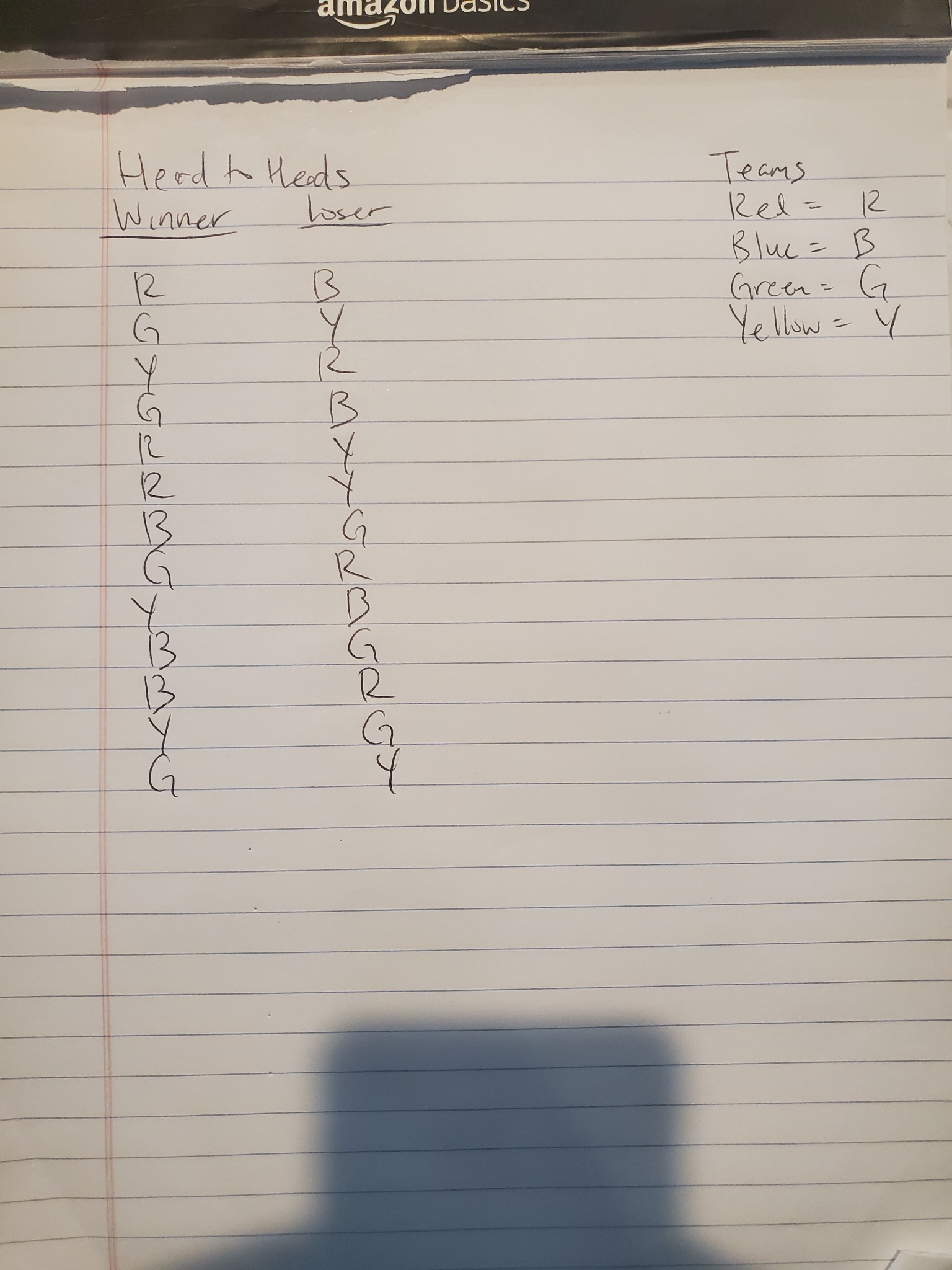
I sent that photo to an AI system and it spit out the following:
| Team Name | Wins | Losses | Win Percentage |
| Green | 4 | 3 | 0.571 |
| Red | 3 | 3 | 0.5 |
| Blue | 3 | 3 | 0.5 |
| Yellow | 3 | 4 | 0.429 |
It captured the data perfectly. The win percentage is a trivial way to “run” this competition, but it’s beside the point. The AI was able to transcribe the individual results perfectly. With that ability, you can devise infinitely more interesting, fun, and most importantly, useful competitions.
From fun or development… to fun AND development
This is the big unlock: When the cost of collecting meaningful data and connecting it with the rest of your data approaches zero, you suddenly have the ability to design games that unlock the competitiveness of your players AND tie to the skills you need them to develop.
This is how you replace Knockout — not by skipping it, but by building something just as exciting, only smarter. Custom-fit to your team. Based on the skills that actually matter while replacing the collection, entry, and calculation step with something automatic.
It makes me think about other applications – tracking improvement over time, creating more sophisticated scoring systems that account for difficulty, or even running team-wide challenges across multiple practices. When you have good data, anything is possible.
AI won’t run the drill for you. But it can make it easier to turn good drills into great games. And that’s how you get the competitive juices flowing in a direction that makes a real difference.
Expected Goals Newsletter
This was originally published in our daily newsletter, Expected Goals, on Jun 7th. If you want to get more coverage and analysis like this, straight in your inbox every morning, sign up here. It’s free and over 1,300 other lacrosse folks have signed up.


July 24, 2025 @ 11:30 am
Which AI system did you use to convert the image to data?
July 29, 2025 @ 7:16 am
I used Gemini’s chatbot for the test. I believe I tried either Claude or ChatGPT as well, but Gemini was the most effective. I haven’t verified it via the API, but I see no reason that it shouldn’t work at scale.
Since I did this initial test, I’ve even played around with creating a worksheet that a team could print off and fill out during practice. It would allow you to specify who is playing on a specific line and track shots/goals/turnovers for that period; then you’d switch to the next combination and track the same stats. My gut is that a more structured worksheet would make it easier for teams to incorporate this sort of experimentation into their practice cadence (having to start with a blank piece of paper is no easy). But the same process would be in place: fill out the sheet during practice, upload an image of the sheet, get a report of how effective each combination of players was.
If anyone’s interested in trying this out, I’d love to do a limited test with an early adopter.